How Much Does a Website, Telegram Bot or App Cost in 2026?
Starting prices for a landing page, website, online store, Telegram bot, Mini App and mobile app, what makes a project cost more and what you pay after launch.
Short answer: a simple version starts at $200 for a landing page, a Telegram bot or a Telegram Mini App, at $300 for a corporate website or a native iOS or Android app, and at $500 for an online store with a cart and payment. CRM and ERP systems are priced individually, once the task is clear. The final price depends on how much the project has to do, and a few costs go to third parties: the domain, hosting and store accounts.
Each service below links to its detailed guide.
My starting prices
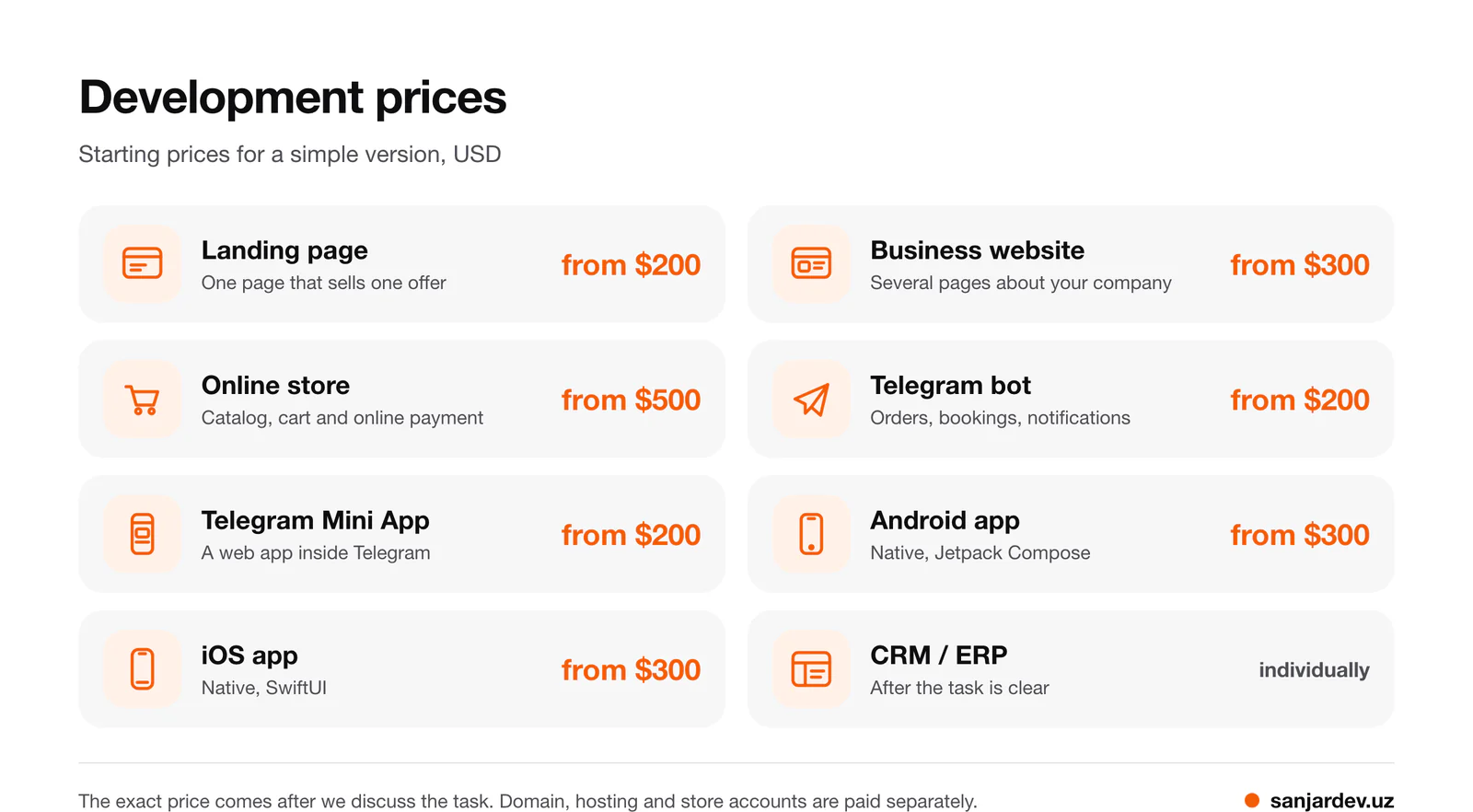
| Service | From | A simple version, for example |
|---|---|---|
| Landing page (one-page site) | $200 | One page about one offer, with a request form or a button to message you |
| Corporate or business card website | $300 | A few pages: the company, services or products, contacts |
| Online store | $500 | A catalog, a cart and online payment |
| Telegram bot | $200 | Menu buttons, answers to common questions, requests sent to you |
| Telegram Mini App | $200 | A small web app that opens inside Telegram, such as a catalog or a booking form |
| Android app (native, Jetpack Compose) | $300 | A few screens for one platform, without accounts or payments |
| iOS app (native, SwiftUI) | $300 | The same, for iPhone |
| CRM / ERP | individually | Priced once your processes are clear |
These are prices for a simple version, not packages: a bot that answers questions and a bot that takes orders and payments, with an admin panel, are very different amounts of work.
A native app is built separately for each platform, so iOS and Android are two apps with two prices. A CRM or ERP system (for customers, stock, finance and staff) depends entirely on your processes, so I estimate it after we have gone through them.
Not sure which of these you need? Start with where to start selling online.
What makes a project cost more
Each of these adds work to the simple version:
- Size. Every page or screen has to be designed, built and tested.
- An admin panel. If you want to change products, prices and texts yourself, the project needs an admin panel: a private part where you manage the content. In the Primefoods.uz store, the owners manage the catalog and prices, process orders and see the customer base from one panel.
- Integrations. Each connection to another service through its API (the interface systems use to exchange data) is separate work with its own testing: payments (in Uzbekistan, for example, Payme, Click and Uzum Bank), SMS, delivery, a CRM, maps. In my MyPark system for amusement parks, Payme and Click each got a separate adapter that handles every step of a payment, including cancellation, checks the provider's signature and never counts a payment twice.
- Accounts and roles. Registration, personal accounts, order history, different rights for the owner, a manager and a cashier.
- Design. A clean design from standard elements takes less time than a unique one with illustrations and animation. Before development I make a prototype and screen designs, so you see how everything will look before it is built.
- Content and languages. Someone has to write the texts, take the photos and translate. Each extra language is another version of every text, button and message: the imzonamangan.uz website, for example, works in Russian, Uzbek and English.
- Several platforms at once. Several channels that share one database cost more than a single channel, but they work as one system. At Ahostel.uz, bookings from the website, the Telegram bot and the mobile apps go into one database, so administrators see the occupancy in real time and double bookings are ruled out.
- The deadline. A rushed deadline means moving other work, and that can raise the price. A realistic deadline is the cheapest one.
What you pay once and what you keep paying
Development is mostly a one-off payment. Most running costs go to other companies, and you should see them before you start.
| Cost | Paid to | How often |
|---|---|---|
| Development | The developer | Once for the agreed scope, or for the time spent |
| Domain name (the site's address) | A domain registrar | Every year, or several years ahead |
| Hosting (the server the project runs on) | A hosting provider | Monthly or yearly |
| Apple Developer Program | Apple | US$99 a year |
| Google Play developer account | US$25, once | |
| Payment provider fee | The payment provider | A share of each payment |
| SMS, calls, maps, AI and other paid services | Each service | By usage |
| Bug fixes in the agreed work | The developer | Free for three months after launch |
| Changes and new features | The developer | When you need them |
So what a website costs per month or per year is mostly hosting, the domain and the paid services it uses. Their prices depend on the provider and the domain zone, so ask for them to be listed in the estimate, next to the development price.
A Telegram bot or Mini App needs no developer account in the app stores: it runs on your server, and Telegram does not charge for creating bots. A mobile app does need store accounts; the details are in how to publish an app. Payment fees depend on the provider and your contract with it: see how to accept online payments.
Usage-based costs grow with your business. In ai-xodim.uz, my catalog of AI agents, every message in the live demo chat is a paid request to the OpenAI API, so the project limits requests per visitor and uses an inexpensive model by default.
A website builder or a ready-made bot service is cheaper to start, but it charges a subscription for as long as you use it and limits you to its features. When that is enough: bot builder or custom development and, for websites, which website a business needs.
Fixed price or time and materials
I work both ways.
| Fixed price | Time and materials | |
|---|---|---|
| How it works | The scope and the price are agreed before work starts | You pay for the time actually spent |
| Best for | A clear task: a landing page, a bot with a known list of functions | A task still taking shape, or a product that changes after every release |
| Changes | A change of scope is estimated separately | Changes are part of the work |
| What you get | A known total | Flexibility; the total is an estimate |
Either way the work goes in stages, and I show the result at each stage. How stages, the contract and payments work: how a development project works.
How to get an exact estimate
The more of this you send, the closer the first estimate is to the final price:
- The goal: what the project should do for your business and who will use it.
- What the first version must do, and separately what can wait.
- Two or three examples you like, and what you like about them.
- What you already have: texts, photos, a logo, a domain, a price list, a system to connect to.
- The integrations: payment, delivery, CRM, accounting.
- The deadline and, if you can, a budget range.
A project brief covers all of this, and there is a free template. I reply with questions and an estimate, and after the first conversation the plan gives exact dates.
If you compare offers from several developers, compare what is included, not only the total: how to choose a developer.
Questions about prices
Can I start small and add features later?
Yes, and it is often the best use of a budget. Qarz Daftar began as a replacement for the paper debt book in shops and has grown into an accounting system with a cash register, stock, installment schedules and automatic SMS and calls to debtors. Plan the first version so it can grow: the database and the server part are the hardest things to change later.
Are hosting and the domain included?
No, you pay the providers directly, ideally on accounts in your name. Setting up the server and putting the project live are part of my work.
How much does it cost to maintain a website?
Hosting, the domain and any paid services it uses. If the site has an admin panel, you change texts, prices and products yourself without paying a developer. Changes to how the site works are new work, estimated as a fixed price or by time.
Discuss your project
Write to me on Telegram, WhatsApp or by e-mail: describe the task in a few sentences, and I will reply with questions and an estimate. I have been building products for businesses for 15 years and work directly with clients, without an agency, wherever they are. You can write in your own language; calls are possible in Uzbek, Russian, Turkish or English.
Sanjar Jabborov — fullstack developer, Tashkent. Updated on 13 November 2026.