Website, Telegram Bot, Mini App or App: Where to Start Selling
A decision guide for selling online: when a website, a Telegram bot, a Mini App, a mobile app or a marketplace fits your goal, audience and budget.
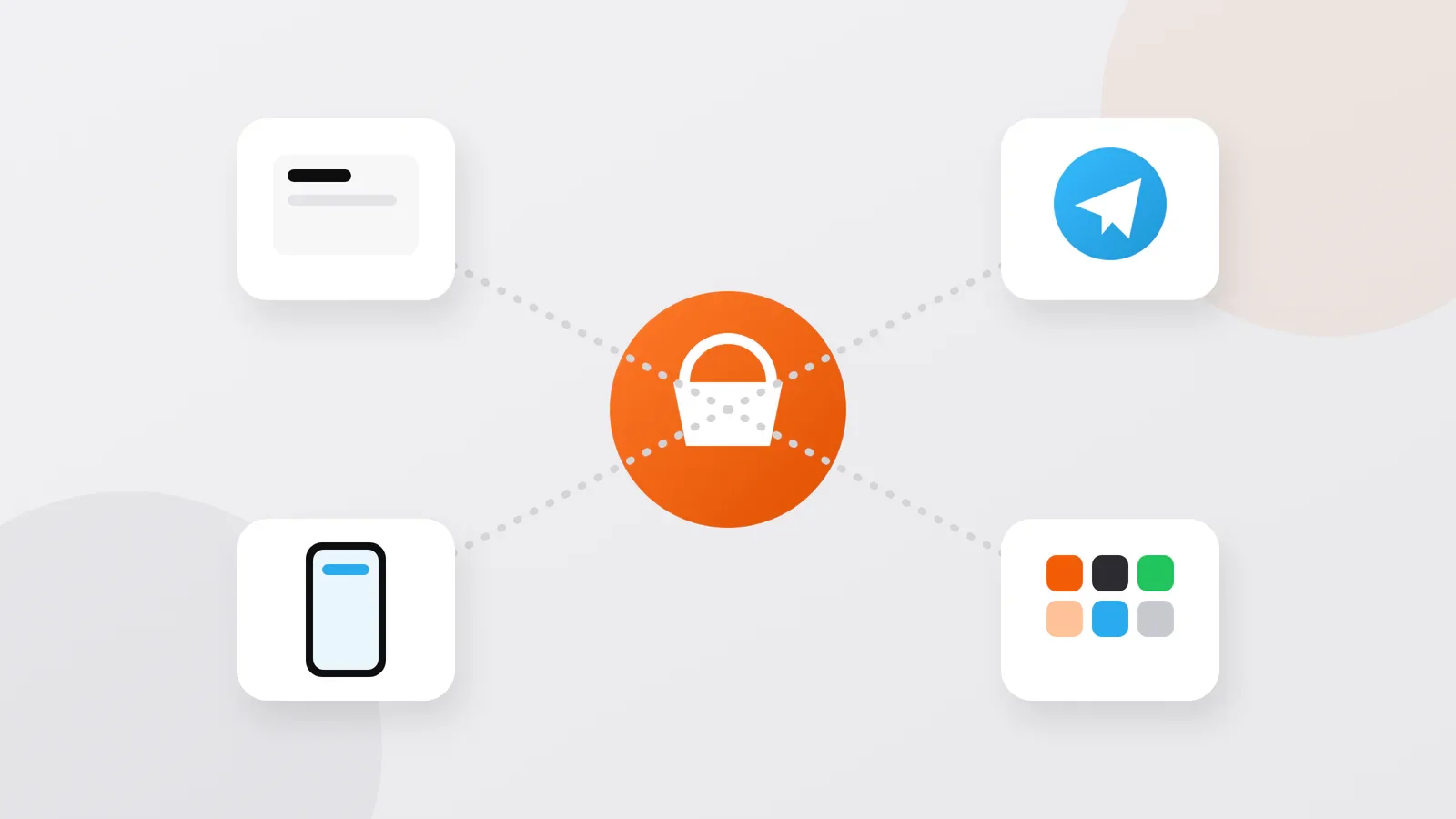
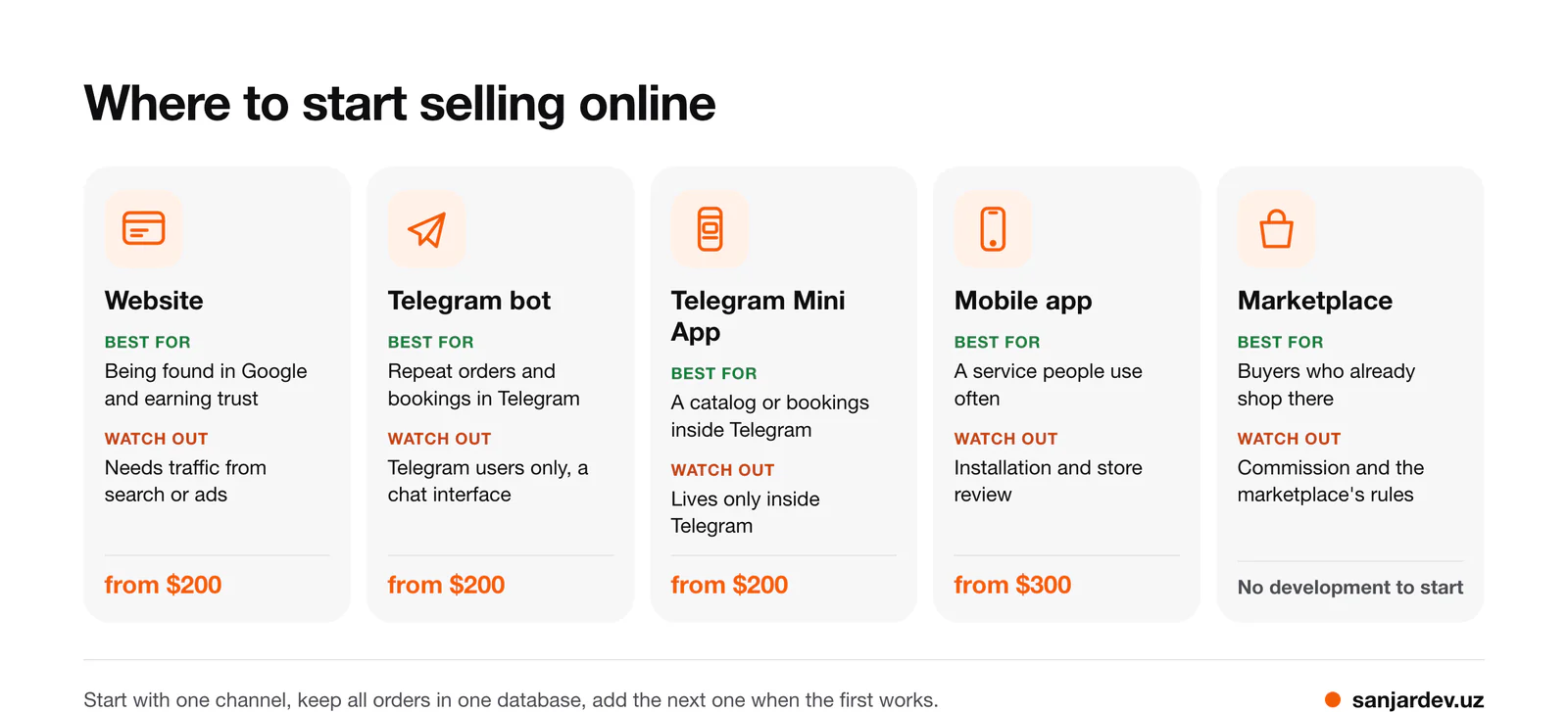
Short answer: Choose the first channel by the job it has to do. A website, if new customers look for you in Google; a Telegram bot, if your customers already write to you in Telegram and order again and again; a Mini App, when a chat is too cramped for your catalog or bookings; a mobile app, when people use your service often enough to keep it on their phone; a marketplace, if you sell goods and want buyers without building a store. Start with one channel, keep all orders in one database, and add the next one when the first works.
Five questions before choosing
Answer these before you think about technology:
- Where do your customers come from today? Google search, Instagram, Telegram, word of mouth, a marketplace.
- Are they new or returning? A website helps strangers trust you; a bot or an app serves people who already know you.
- What do they do? Buy goods, book a time, ask for a quote, or use your service every day.
- How complex is the choice? Five products and one button, or hundreds of items with filters and dates.
- Who handles the orders, and where? In a Telegram group, in an admin panel, or in your CRM (customer database) or accounting system.
I build websites, Telegram bots, Mini Apps and native mobile apps myself, so I have no reason to push you toward the most expensive option. Honest answers to these questions usually leave one or two candidates.
The options side by side
| Channel | Best first job | Weak spots | Starting price (my work) |
|---|---|---|---|
| Website | Being found in Google, earning the trust of new customers, a page for ads | Needs traffic from search or ads; cannot remind customers about itself unless you collect contacts | landing page from $200, website from $300, online store from $500 |
| Telegram bot | Repeat orders, bookings and notifications for customers who use Telegram | A narrow chat interface; cannot message people first; Telegram users only | from $200 |
| Telegram Mini App | A catalog, filters, a calendar or an account inside Telegram, with nothing to install | Lives only inside Telegram; no presence in Google search | from $200 |
| Mobile app | A service used often: accounts, loyalty, daily tools, push notifications | Has to be installed; store review; iOS and Android are two apps to build and update | iOS from $300, Android from $300 |
| Marketplace | Buyers who already shop there; no store to build | Commission and the marketplace's rules; the relationship with the buyer mostly stays with the marketplace | no development needed to start |
Which channel fits which business
Examples from my projects:
- Repeat orders in one city, such as food delivery. A Telegram bot is often the quickest start (what a bot can do and what it costs). Meatline used to take orders by phone and in messages; now customers choose from a catalog in the bot, share a location instead of typing an address, and managers get each order with a map link.
- Bookings: a hostel, a hotel, a park. Several channels help here, but they must share one database. For Ahostel I built a website with booking, a Telegram bot with a Mini App, and native iOS and Android apps. All bookings go into one database, so administrators see occupancy in real time and double bookings are ruled out.
- Retail and wholesale goods. A website store does what a chat cannot do well: separate sign-up for individuals and companies, smart filters, order history and repeating a past order in one click, as in Primefoods. What a store needs behind the scenes — payments, delivery, stock, an admin panel — is covered in online store: website, bot or app.
- A campaign that should spread. A Mini App needs no installation and is easy to share. Dinay's New Year Mini App let people turn a photo of themselves into an AI-generated card and share it to Telegram Stories in one tap (what a Mini App is).
- A service used every day. This is where an app earns its place. Qarz Daftar, my debt-accounting app for shops, runs natively on iOS and Android with a web account, and records made without internet sync once the connection returns — something a bot cannot do.
- You already sell on a marketplace. Your own store can wait; automation around the marketplace may pay off sooner. My own service for sellers on Uzum Market, a large marketplace in Uzbekistan, books supply time slots at the marketplace's warehouses through Telegram.
Start small and grow without rebuilding
You rarely need every channel at once. Launch one, watch how customers use it, then add the next. Two rules keep that growth cheap:
- One server and one database for all channels. If the bot, the website and the app read and write the same data, a new channel means a new front end, not a new system. My app PRORAB works this way: one backend serves the iOS app, the Android app and the landing page, and data entered on a phone or in the admin panel is available everywhere at once.
- One order list for your team. Wherever an order comes from, staff should see it in one place, with one set of statuses.
One sensible order for a business that sells through Telegram: a bot first; a Mini App on the same bot when the catalog outgrows the buttons, so customers stay in the same chat; a website when you want customers from Google; an app when people use you often enough to install it.
Budget: count more than development
Development is a one-off payment. Each channel also has running costs:
| Channel | Recurring costs to plan for |
|---|---|
| Website or online store | Domain and hosting, paid to the providers; payment provider fees |
| Telegram bot or Mini App | Hosting, because the server works around the clock; a domain for a Mini App; payment provider fees. Telegram does not charge for its bot platform |
| Mobile app | Apple Developer Program, US$99 per year; Google Play, a US$25 one-time registration fee; hosting for the server |
| Marketplace | Commission and fees set by the marketplace |
For every channel, someone also has to answer customers, update the catalog and process orders, and that time is a cost too. Starting prices and what changes them are explained in how much a website, bot or app costs.
Frequently asked questions
Do I need a website if I have a Telegram bot?
If new customers search for businesses like yours in Google, yes: a bot does not replace a site in search results. If customers come from Instagram or word of mouth and write to you in Telegram anyway, a bot can be enough at the start, and a one-page site can follow later.
Should I start on a marketplace?
For goods, it can be a reasonable start: the buyers are already there. Your own website or bot becomes worth it when you want repeat customers on your terms — your prices, your customer base, your communication.
Is a mobile app worth it for a small business?
When customers use it often — daily tools, accounts, loyalty — yes. For an occasional order, asking a customer to install an app is a lot; a bot or a website asks less.
Can one developer build all of these?
I do: websites, Telegram bots and Mini Apps, native iOS and Android apps, and the server behind them, which is what lets them share one database.
Discuss your project
Tell me what you sell, where your customers come from and how orders arrive today, and I will suggest where to start and what can wait. Write to me on Telegram, WhatsApp or by e-mail, and I will reply with questions and an estimate. You can write in your own language; calls are in Uzbek, Russian, Turkish or English.
Sanjar Jabborov — fullstack developer, Tashkent. Updated on 13 November 2026.