Telegram Mini App: What It Is, When You Need One, What It Costs
A Telegram Mini App is a web app that opens inside Telegram. How it differs from a bot, a website and a mobile app, how payments work, what drives the cost.
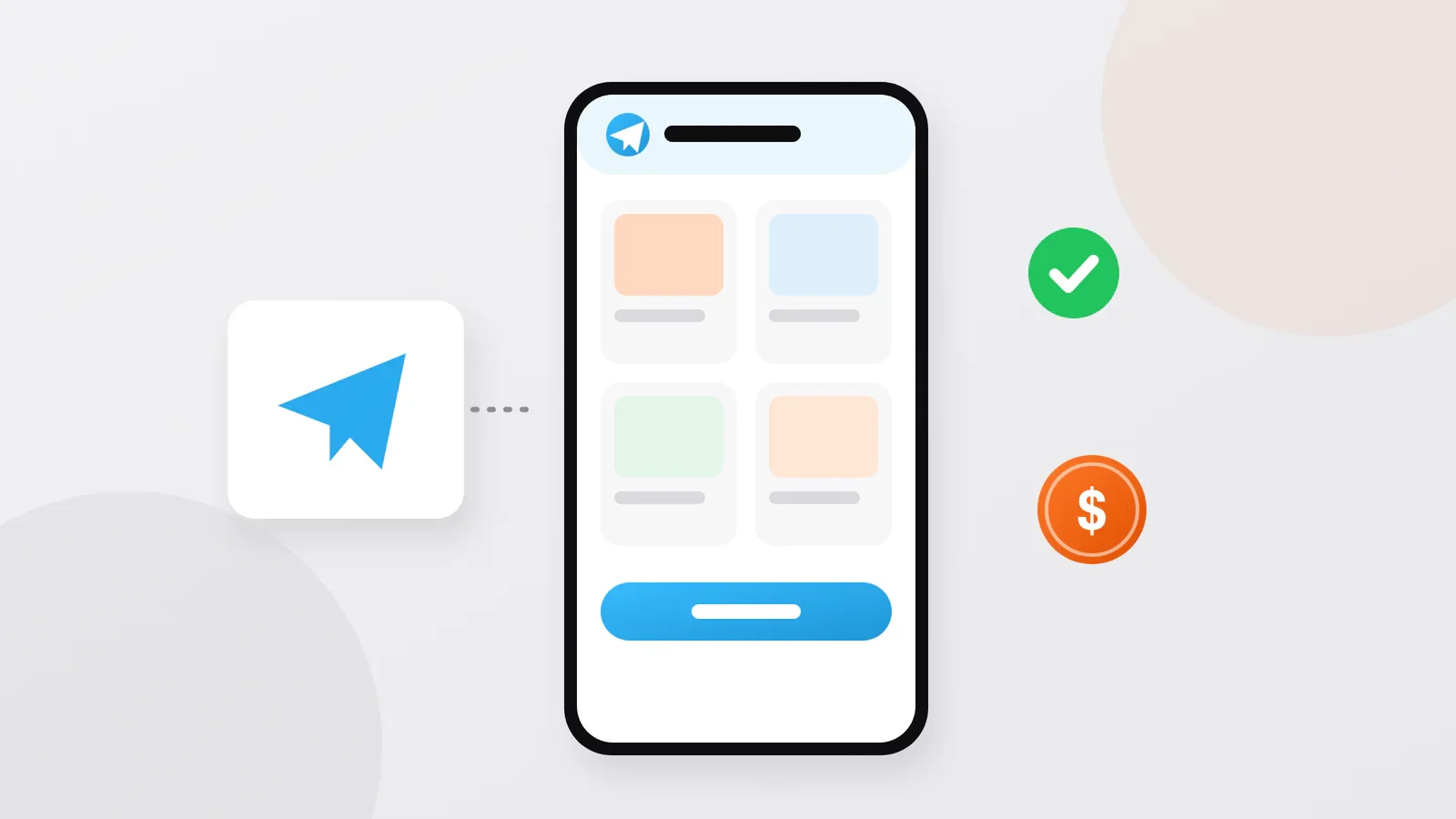
Short answer: A Telegram Mini App is a web application that opens inside Telegram from a chat with a bot: real screens with photos, filters, forms and a cart, with nothing to install and often no separate sign-up. It fits when a chat with buttons is too cramped — a large catalog, a booking calendar, a personal account, an interactive tool. I build Mini Apps from $200 for a simple version; the price depends on the screens, the admin panel, payments and integrations.
What a Mini App is, in plain words
Technically, a Mini App is a website that Telegram opens in its own window. Telegram's documentation describes Mini Apps as interfaces built with JavaScript that are "launched right inside Telegram" and "can completely replace any website". Every Mini App belongs to a bot and opens from it: from the menu button in the chat, a button under a message, a direct link or the bot's profile — Telegram lists seven ways in all.
What this gives a business:
- Nothing to install and often no sign-up. It opens in the Telegram app the customer already has, and Telegram passes it basic information about the user, such as the name and language. A careful developer verifies the signature of this data on the server before trusting it.
- It looks at home in Telegram. It follows the user's color theme, can go full-screen and can offer a shortcut on the phone's home screen.
- The bot stays in the loop. Confirmations and reminders arrive as messages from the bot, in the same chat.
Mini App, bot, website or mobile app
| Chat bot | Mini App | Website | Mobile app | |
|---|---|---|---|---|
| Interface | Messages and buttons | Full screens inside Telegram | Full screens in a browser | Full screens and device features |
| How new customers find it | Links, your channel, Telegram search | Links and buttons in the bot | Google search, ads, links | Store search, ads, links |
| Reaching the customer again | Messages in the chat | Messages from its bot | E-mail or SMS, if you have contacts | Push notifications |
| Starting price (my work) | from $200 | from $200 | landing page from $200, website from $300 | iOS or Android, from $300 each |
What follows from the table:
- Compared with a bot, a Mini App is the same bot plus screens: a bot suits short paths and weak internet, a Mini App suits choices with many options (what a Telegram bot can do).
- Compared with a website, it gives you no place in Google search. Telegram's Mini App Store features selected successful apps, so plan to bring customers yourself: your channel, Instagram, a QR code at the counter.
- Compared with a mobile app, there is no store review, and one version works on every phone; for a tool people use daily or need without internet, an app is still better.
When a Mini App is the right choice
- The catalog is too big for buttons. Categories, filters, photos and a cart work better on a screen than in a chat.
- The choice has many parameters: dates, rooms, seats, time slots. In the Ahostel project a guest chooses a room in the Mini App and pays without leaving Telegram, while the bot answers frequent questions and sends the hostel's location.
- The experience is interactive: upload a photo, choose a style, get a result, as in the Dinay example below.
- It is a tool people come back to. My own service for Uzum Market sellers, which books supply time slots at the marketplace's warehouses, is a Telegram bot with a Mini App, so sellers have nothing to install.
- Your customers already live in Telegram. In Uzbekistan, for example, Telegram is the main messenger.
When not to choose one: for a short path — a few items, a phone number, an address — a classic bot is simpler. Meatline got a chat bot on purpose: its customers of all ages find chat buttons easier than a web interface, and a chat bot works reliably on weak mobile internet.
Example: Dinay's New Year card generator
For the New Year, the Dinay Uzbekistan brand wanted a simple, fun tool that lets people create a New Year card with themselves in it, without leaving Telegram. I built it as a Mini App with AI image generation:
- The user opens the Mini App and picks a language.
- They choose a photo from the gallery or take a selfie right in the app.
- They pick one of five New Year styles.
- The neural network transforms the photo (the image-to-image technique): it keeps the person's facial features and changes the surroundings and the style.
- The bot sends the finished card to the user's chat, and one tap shares it to Telegram Stories.
The business idea is user-generated content: every shared card shows the brand to the user's friends. Uploading, choosing a style and seeing the result need screens, which a chat cannot give. Read the Dinay case.
Payments inside a Mini App
What you sell decides how the customer pays:
- Physical goods and services — food, delivery, rooms, tickets. Payment goes through a third-party payment provider connected to the bot: the Mini App opens Telegram's payment form, with Google Pay and Apple Pay supported out of the box. Telegram says it "doesn't collect payment information and takes no commission"; the provider's fees apply, and disputes and refunds are the bot owner's responsibility, that is, the business's. A Mini App can also open the provider's own payment page in the browser, as a website would.
- Digital goods and services — subscriptions, digital content, in-app items. Inside Telegram they must be sold for Telegram Stars, a currency users buy in Telegram; Telegram explains this by the rules of the App Store and Google Play. Refunds of Stars payments go through the Bot API.
Which providers you can connect depends on your country and your business; in Uzbekistan, for example, I work with Payme, Click and Uzum Bank. The guide to accepting payments explains gateways, merchant agreements and fees.
What drives the cost of a Mini App
A simple Mini App starts at $200. What adds to the estimate:
- Screens. A catalog, a product page, a cart and checkout is one scope; a personal account, order history or a booking calendar adds more.
- Design. Following Telegram's own look and theme colors is simpler than a custom brand design for every screen.
- The admin panel for products, prices, orders and content.
- Payments: a provider, payment statuses and refunds, or Telegram Stars for digital goods.
- Integrations with a CRM, accounting, a warehouse, maps, delivery or AI models. AI also adds running costs: every generation uses computing power that someone pays for.
- The bot part, languages and load: notifications, every language version, and a server ready for a campaign that brings many users at once.
A Mini App is a website, so it needs hosting and a domain — Telegram requires an HTTPS address — paid to the providers. One-off and recurring costs are listed in how much a website, bot or app costs.
Frequently asked questions
Can a Mini App replace my website?
For customers who already come to you through Telegram, it can do most of a website's job. But it does not put you in Google search results, and people without Telegram will not reach it. If you are deciding where to start, see where to start selling online.
How long does it take to build?
A simple Mini App takes days rather than months; one with payments, an admin panel and integrations takes longer. You see the screen designs before development starts, and the plan after our first conversation gives exact dates.
Can I build a Mini App in a builder?
For a standard case, such as a simple shop, Mini App builders and templates can be enough. The trade-off is the same as with bot builders: a subscription and the limits of the platform once you need your own design or logic.
Sources
- Telegram: Telegram Mini Apps — features, invoices, the Mini App Store.
- Telegram: Bot Payments API — physical goods and services.
- Telegram: Bot Payments API for Digital Goods and Services — Telegram Stars.
- Telegram: Bot API, WebAppInfo — HTTPS address.
Discuss your project
Tell me what your customers should do in the Mini App — browse, book, pay, create — and where the orders should go. Write to me on Telegram, WhatsApp or by e-mail with a few sentences about the task, and I will reply with questions and an estimate. You can write in your own language; calls are in Uzbek, Russian, Turkish or English.
Sanjar Jabborov — fullstack developer, Tashkent. Updated on 13 November 2026.