Software Development Process: Stages, Contract and Payments
The software development process for a website, bot or app, step by step: stages, what the contract covers, payment by milestones and a clean handover.
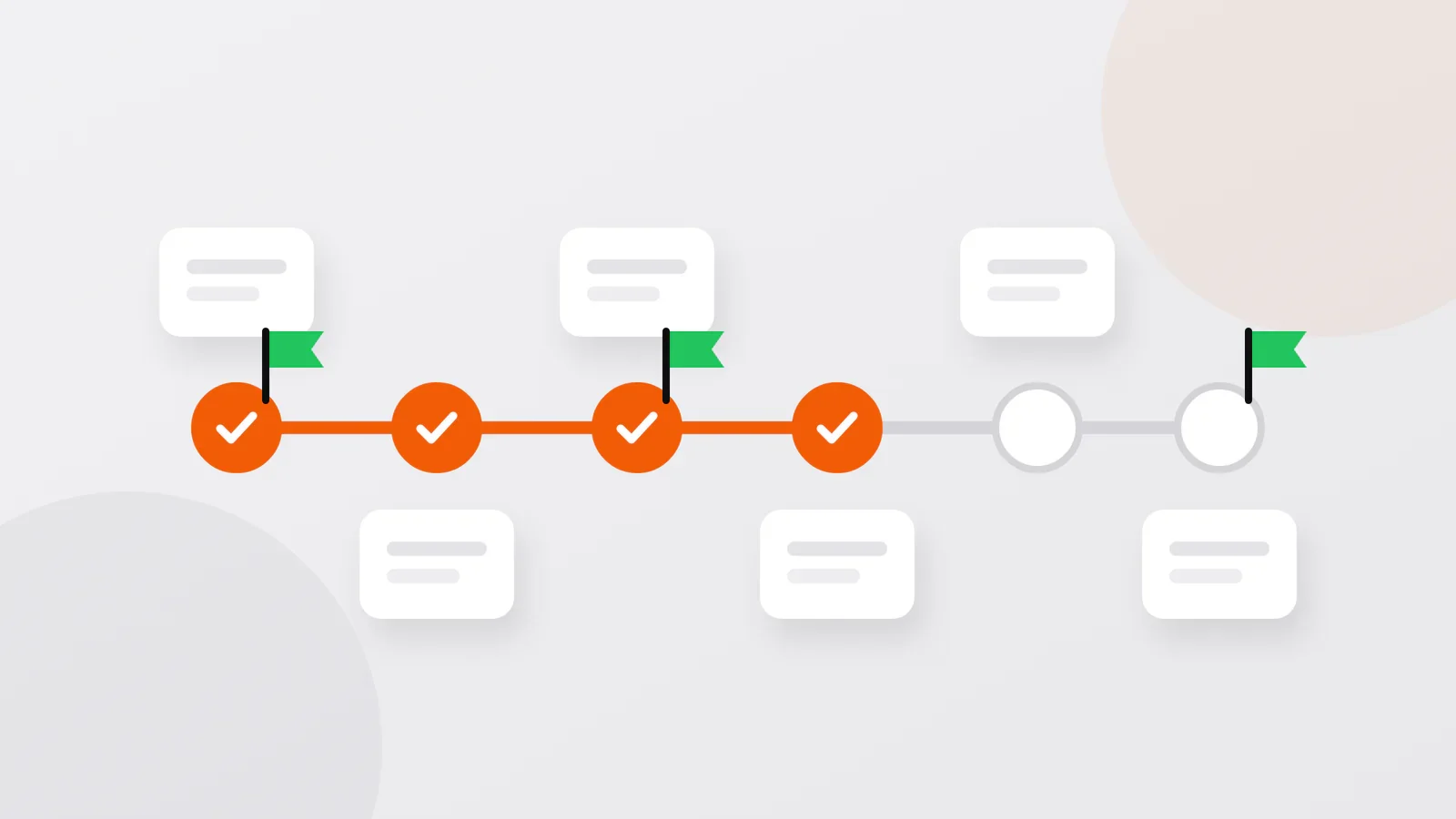
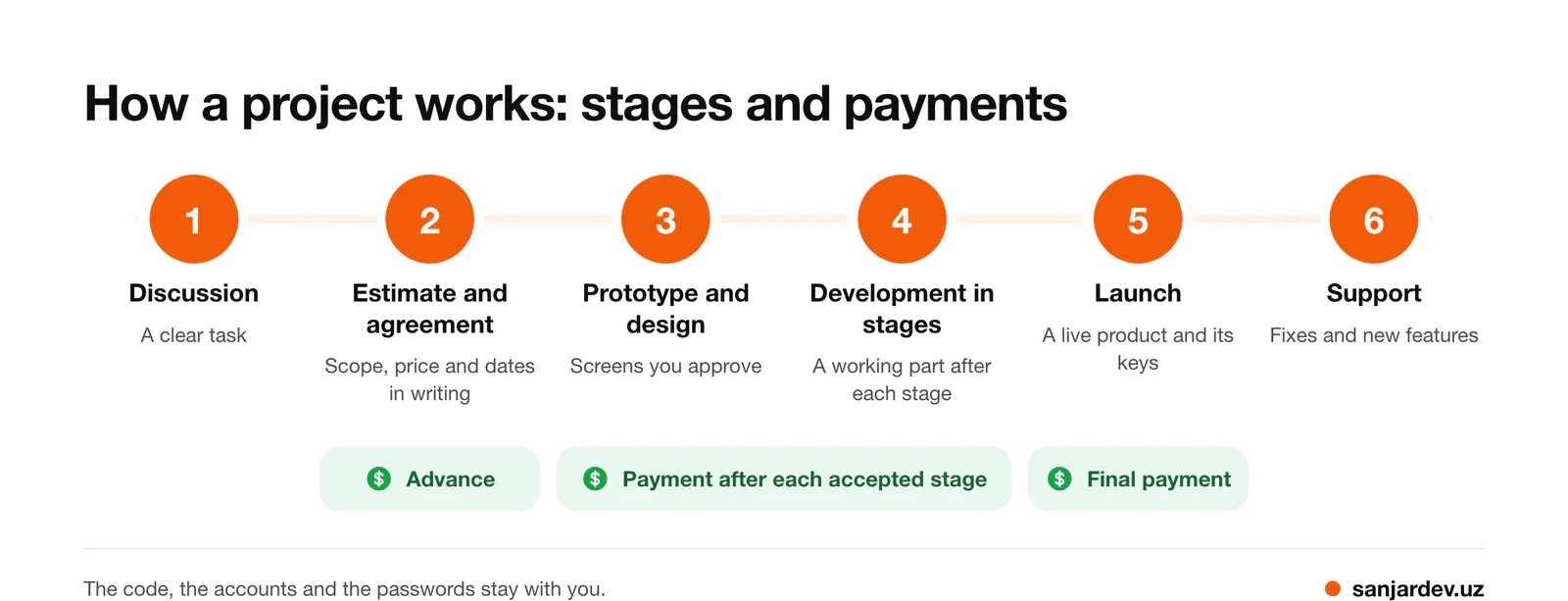
Short answer: A website, bot or app project goes through six stages: discussion, estimate and contract, prototype and design, development in stages with demos, launch, and support. Payment is tied to milestones: you pay for one stage at a time and see its result before the next one starts, so neither side is ever far ahead of the other. At the end, the code, the accounts and the passwords stay with you.
The six stages at a glance
| Stage | What happens | What you get |
|---|---|---|
| 1. Discussion | We talk about goals, customers and current processes | A clear task and a proposed solution |
| 2. Estimate and contract | Scope, stages, price and dates are written down | An estimate and a contract |
| 3. Prototype and design | Screens are drawn before any code is written | A prototype and designs you approve |
| 4. Development in stages | Code, payments, CRM and Telegram integrations | A working part to try after each stage |
| 5. Launch | The site or bot goes live, the app goes to the stores | A live product, and the keys to it |
| 6. Support | Fixes, updates, new features | A developer who stays in touch |
1. Discussion: understanding the task
Before any talk of technology, I ask about the business: what the project should achieve, who the customers are, how things work now. The goal is a solution that fits the business, and it is sometimes simpler than the one the client had in mind.
For Meatline Tashkent, a producer of sausages and meat delicacies, we deliberately chose a classic chat bot over a Mini App (a web app that opens inside Telegram). The brand's customers are people of different ages, many of them find familiar chat buttons easier, and such a bot works reliably even on weak mobile internet.
A written brief makes this stage faster: here is how to write one, with a free template.
2. Estimate and contract
After the discussion you get an estimate: what will be built, in which stages, for what price and by when. I work in two ways, and the estimate says which one applies:
- Fixed price. The scope is agreed in advance, and the price changes only if the scope does. Good when the task is clear.
- Time and materials. You pay for the hours actually spent. Good when the project will change as you learn, such as a new product tested on real customers.
What makes a project cost more is explained in the cost guide.
Whatever its form, the contract should cover:
- Scope: what is included and what is not; once approved, the prototype becomes part of it.
- Stages and acceptance: the result of each stage and how you confirm it.
- Payments: the amount for each stage and when it is due.
- Changes: how new requests are estimated and added.
- Ownership: the code, designs, domain and accounts belong to the client.
- Bug fixes: whether a period of free fixes is included, and how long it lasts.
- Support: included or agreed separately.
- Stopping: what happens to the work and the money if either side ends the project.
This is practical advice, not legal advice: the form and wording of a contract depend on your country, so discuss them with a lawyer in your country, especially when the developer works abroad.
3. Prototype and design
A prototype is a simple model of the screens: what is where and which button leads where. Then come the screen designs, which show how everything will actually look. You see the whole product before development starts.
This is the cheapest moment to change your mind: changing a screen in a design is quick, changing it after the code and the database are built is real work. Show the prototype to colleagues or to a few customers.
4. Development in stages, with demos
I write the code, connect payments, the CRM and Telegram, and show the result stage by stage. After each stage you get something you can try yourself: pages on a test address, a bot that answers, an app on your phone.
Stages also let you use parts early. On ai-xodim.uz, my catalog of AI agents for businesses, the admin panel and the data model were built first and the public pages after, so the catalog could be filled with content before the final front end was ready.
New ideas during development are normal. Write each one down, estimate it, and decide together whether it goes into the current stage, a later one or the next version; that keeps the agreed dates realistic.
Payment by milestones
A milestone is a stage with a clear, visible result. Payment by milestones ties the money to these results:
- An advance before the first stage, so the developer reserves time for your project.
- A payment after each accepted stage: you have seen and tried the result, you pay, and the next stage starts.
- A final payment at launch and handover.
The exact split depends on the project and is written in the agreement. The principle matters more than the numbers: you never pay far ahead of the work you have seen, and the developer is never far behind on payment for work already done. With time and materials, the same idea works through regular invoices for the hours spent, each with a report of what was done.
What you provide
Some things only the business can give:
- a person who makes decisions and answers questions without long delays;
- content: texts, photos, prices, the list of products or services;
- accounts in your name: the domain, hosting or a server, the Telegram bot and, for apps, the App Store and Google Play developer accounts. Any fees go from you to the provider directly, for example US$99 per year for the Apple Developer Program and a US$25 one-time fee for Google Play;
- a contract with a payment provider if the project takes payments, such as Payme, Click or Uzum Bank in Uzbekistan. The provider signs it with your business, not with the developer: see how online payments work;
- feedback on each demo within the agreed time.
Launch and handover
Launch means the site or bot goes live on your domain and server, and the app goes to the App Store and Google Play. Publishing an app takes store descriptions, screenshots, a privacy policy and an age rating: for my app PRORAB, built for construction foremen, all of this was prepared to meet the requirements of both stores. More in the guide to publishing an app.
At handover, everything stays with you:
- the source code, in a repository (online storage for code) you have access to;
- logins to the admin panel, the server and every service the project uses;
- the domain, the hosting and the store accounts, already in your name;
- short notes on how the project is deployed and what each service does.
After handover, change the passwords that were shared during the work. Then nobody, including the developer, has access you have not chosen to give.
Support after launch
A live project needs care: server updates, fixes for what real users find, new app versions as iOS and Android change, new features. I stay in touch after launch, and because I set up and maintain servers myself, the person who knows the code also looks after the place where it runs. Bugs in the work we agreed on I fix free of charge for three months after launch; new features and changes are estimated separately. Agree in advance what support includes and how it is paid.
Frequently asked questions
How long does the whole process take?
It depends on the size. A simple landing page takes days rather than months; an app with payments and an admin panel takes longer. The plan after the first conversation gives exact dates for each stage.
Can I change the requirements during development?
Yes. With a fixed price, a change is estimated and added to the plan as a separate item; with time and materials it simply becomes part of the work. Changes are cheapest at the prototype stage.
Do I need a formal contract for a small project?
At least write down the scope, the price, the stages and who owns the result, even in an e-mail that both sides confirm. For larger projects a proper contract is worth it; discuss its form with a lawyer in your country.
Discuss your project
Write to me on Telegram, WhatsApp or by e-mail: describe the task in a few sentences, and I will reply with questions and an estimate. You can write in your own language; calls are possible in Uzbek, Russian, Turkish or English.
Sanjar Jabborov — fullstack developer, Tashkent. Updated on 13 November 2026.