Selling on Credit to Customers: Is It Worth It? 6 Rules
Selling on credit to customers: the real pros and cons for a small shop, six rules that keep losses small, and what to do when a customer does not pay.

Selling on credit keeps regular customers coming back and can raise your sales, but it ties up your cash and some debts are never paid. It is worth it when credit is a rule rather than a favour: only for people you know, with a limit, a fixed due date, a written record, a reminder before the date and no new credit while a debt is overdue.
What selling on credit means
Selling on credit means the customer takes the goods now and pays later: at the end of the week, on payday or in several parts. In a small shop it is usually informal, a line in a notebook rather than a contract, and it has many local names, from fiado in Brazil and Mexico to veresiye in Türkiye and nasiya in Uzbekistan.
It is a normal, legal way to sell. The law treats it as a sale where the payment comes later. Brazil's Civil Code, for example, refers to a "venda a crédito", a sale on credit (art. 491), and Uzbekistan's Civil Code describes a sale where the buyer pays some time after receiving the goods, using the everyday word nasiya (art. 421).
Some countries add rules for credit given to consumers, mostly about information and paperwork. Two examples:
- Mexico. The consumer protection law says that in every credit sale to a consumer, the seller must first tell the customer the cash price, any charges, the number and timing of payments and the total to pay (art. 66).
- Türkiye. A sale where the consumer pays in parts is an installment sale, which is valid only in writing, and the customer may withdraw from it within seven days (Law 6502, arts. 17 and 18).
So check the rules in your country before you charge extra for credit or sell expensive goods in installments.
The pros and cons
| The good side | The cost |
|---|---|
| regulars keep coming back: you become "their" shop | cash is tied up: money for restocking sits in the book |
| people buy what they need now, not only what they have cash for | some debts are never paid |
| you compete with big stores on trust, not only on price | recording, reminding and chasing take time every week |
| customers in a tight week stay loyal instead of going elsewhere | disputes about amounts and awkward talks with neighbours |
The second column is easy to underestimate. If your margin is 20%, one unpaid debt of 50 wipes out the profit from 250 of sales, because 50 divided by 0.20 is 250. A shop that sells on credit has to collect almost everything to come out ahead. That does not mean credit is a mistake. It means the money has to come back.
Is it worth it for your shop?
Answer three questions honestly before you extend credit to more customers:
- Could you restock next week if nobody paid you until the end of the month? Add up everything customers owe you today and compare it with what you spend on goods in a week.
- How much have you written off in the last six months? Count the debts you no longer expect to see, and compare them with the profit credit brought in.
- Who takes credit? Regulars who pay on time are worth it. New faces asking for credit on their first visit are where most losses start.
If the total on credit keeps growing month after month, tighten the rules before you take on more customers.
Six rules for selling on credit
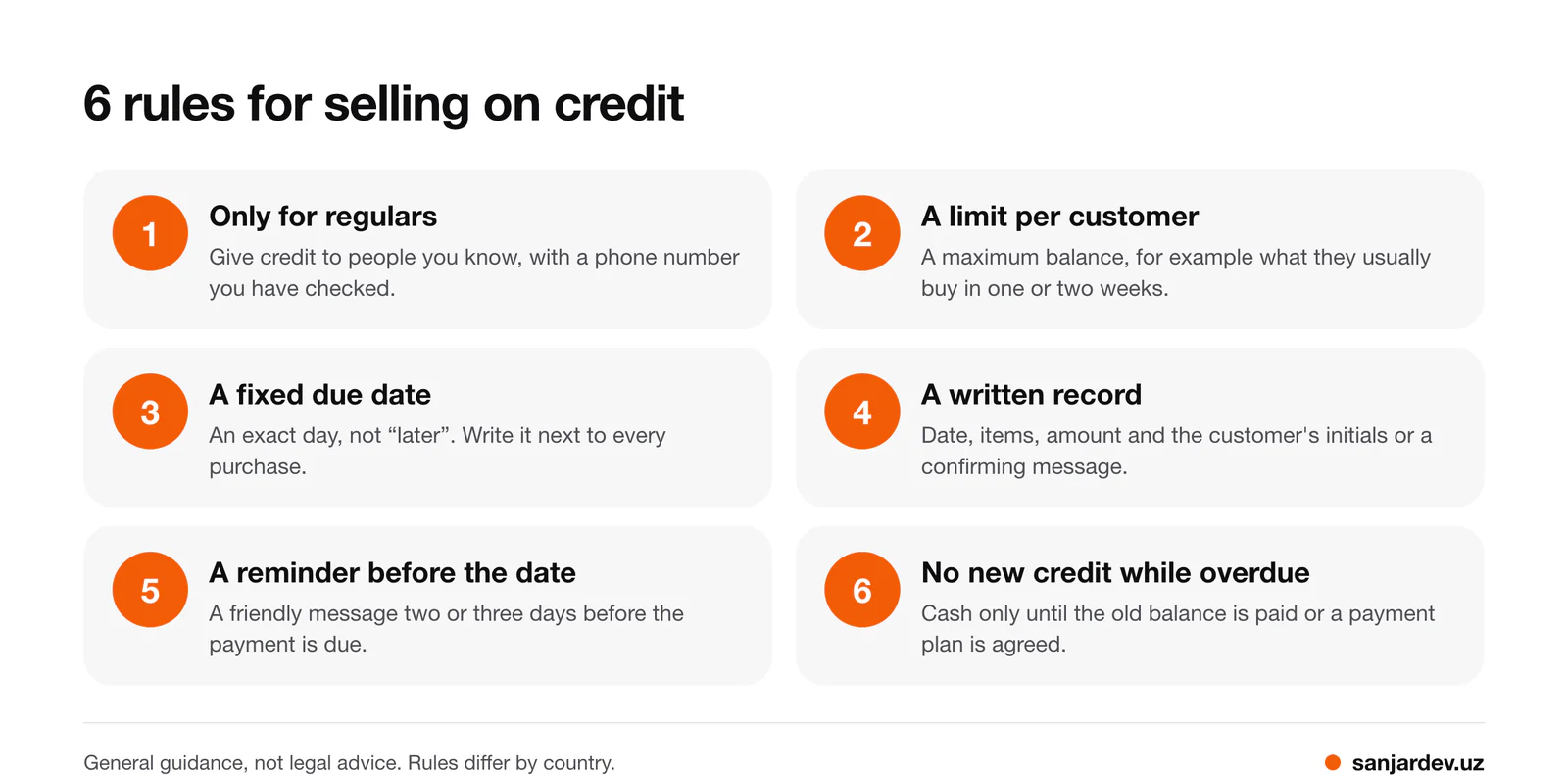
- Only for regulars. Give credit to people you know by name, with a phone number you have checked by calling it once. With a new customer, start small and raise the amount only after they have paid on time a few times.
- A limit per customer. Decide a maximum balance for each person, for example what they usually buy in one or two weeks, and do not go over it, however good the story.
- A fixed due date. Agree on an exact day, not "later" or "when I get paid". If they are paid on the 5th, write the 5th.
- A written record. Write the date, the items, the amount and the due date, and ask for the customer's initials or a confirming message. Our guide to keeping a customer credit book comes with a free printable page.
- A reminder before the date. A friendly message two or three days before the due date often prevents a late payment, because people forget more often than they refuse. Wording is in payment reminder messages.
- No new credit while overdue. Sell for cash only until the old balance is paid or a payment plan is agreed. Present it as a shop rule, the same for everyone, so it does not feel personal.
These rules work best when you apply them to everybody, including friends and relatives. The customers who protest the loudest are usually the ones you most need them for.
What to do when a customer does not pay
- Talk privately and early. A day or two after the due date, ask in person or by message. Often the customer has forgotten, or is short until payday.
- Agree a payment plan. Split the debt into small amounts on fixed dates, write the plan in your book and send it to the customer as a message.
- Stop new credit until the debt or the plan is on track, as rule 6 says.
- Send a firm final notice, calm and factual: the amount, the plan that was missed, and what happens next, such as cash-only sales.
- Consider formal steps only when the amount is worth it. Many countries have simplified court procedures or mediation for small debts, but the rules, fees and deadlines differ, so ask a local lawyer, consumer office or chamber of commerce.
- Write off what will not come back. Mark it in the book, and decide whether this person can buy on credit again.
What not to do matters as much. Do not post a list of debtors, do not contact their employer or relatives, and do not threaten them with the police or prison. Such threats are usually false as well as illegal. Mexico's Constitution says that nobody can be imprisoned for purely civil debts (art. 17), and Brazil's Consumer Defense Code makes threats and false statements in debt collection a crime (art. 71).
FAQ
What does selling on credit mean?
It means letting a customer take goods now and pay later, on an agreed date or in parts. In a small shop the deal is usually recorded in a credit book rather than in a written contract.
What are the advantages of extending credit to customers?
Loyalty and sales: regulars keep buying from the shop that trusts them, they buy what they need even in a week without cash, and a small shop can compete with big stores on trust rather than on price.
What are the disadvantages of extending credit to customers?
Three stand out: your cash is tied up, so it is harder to restock; some customers never pay, and each loss cancels the profit of many sales; and recording and chasing payments takes time and can strain relationships with neighbours.
Should I extend credit only to creditworthy customers?
Yes. In a small shop, creditworthy means a regular you know, with a checked phone number and a history of paying on time. Give them a limit, for example what they usually spend in one or two weeks, raise it only after several on-time payments, and never give new credit while an old balance is overdue.
Is it legal to sell to customers on credit?
In general, yes: civil codes treat it as an ordinary sale with deferred payment. Some countries add rules for consumer credit, for example on what you must tell the customer, written contracts for installments, and interest, so check them before charging extra for credit.
How Daftio helps
Daftio, the app we develop for Android, keeps these rules in front of you at the counter. Before you add a new debt, the customer's card shows the balance and the whole history, and the main screen shows the total owed, the overdue amount and how many customers are late. You set a due date in 7, 15 or 30 days or choose a date; notes such as "promised to pay on Friday" stay on the card, and a ready reminder goes out through WhatsApp, SMS or Telegram when you tap Send. Daftio does not set credit limits for you, lend money or collect debts. Without a subscription it covers one shop and up to 30 customers; Daftio Pro, a yearly subscription with a 7-day trial, adds unlimited customers and statements that settle disputes. Daftio on Google Play.
Sources
- Lei nº 10.406/2002, Código Civil, art. 491 — Câmara dos Deputados, Brazil, 2002 (updated text)
- Civil Code of the Republic of Uzbekistan, part two, arts. 421–422 — National Database of Legislation (Lex.uz), Uzbekistan, 1996
- Ley Federal de Protección al Consumidor, art. 66 — Orden Jurídico Nacional, Mexico, 1992
- Law No. 6502 on Consumer Protection, arts. 17–18 — Mevzuat Bilgi Sistemi, Türkiye, 2013
- Constitución Política de los Estados Unidos Mexicanos, art. 17 — Orden Jurídico Nacional, Mexico, 1917 (text of 2025)
- Lei nº 8.078/1990, Código de Defesa do Consumidor, art. 71 — Câmara dos Deputados, Brazil, 1990 (updated text)
Written by Sanjar Jabborov, developer of Daftio. Checked against the civil, consumer and constitutional texts cited above. Updated on 14 November 2026. This is general information, not legal advice: rules on credit sales differ by country.