Payment Reminder Messages for Customers: 8 Polite Templates
Polite payment reminder messages for customers who owe your shop: when to send them, what to include, 8 templates for WhatsApp or SMS, and what never to do.
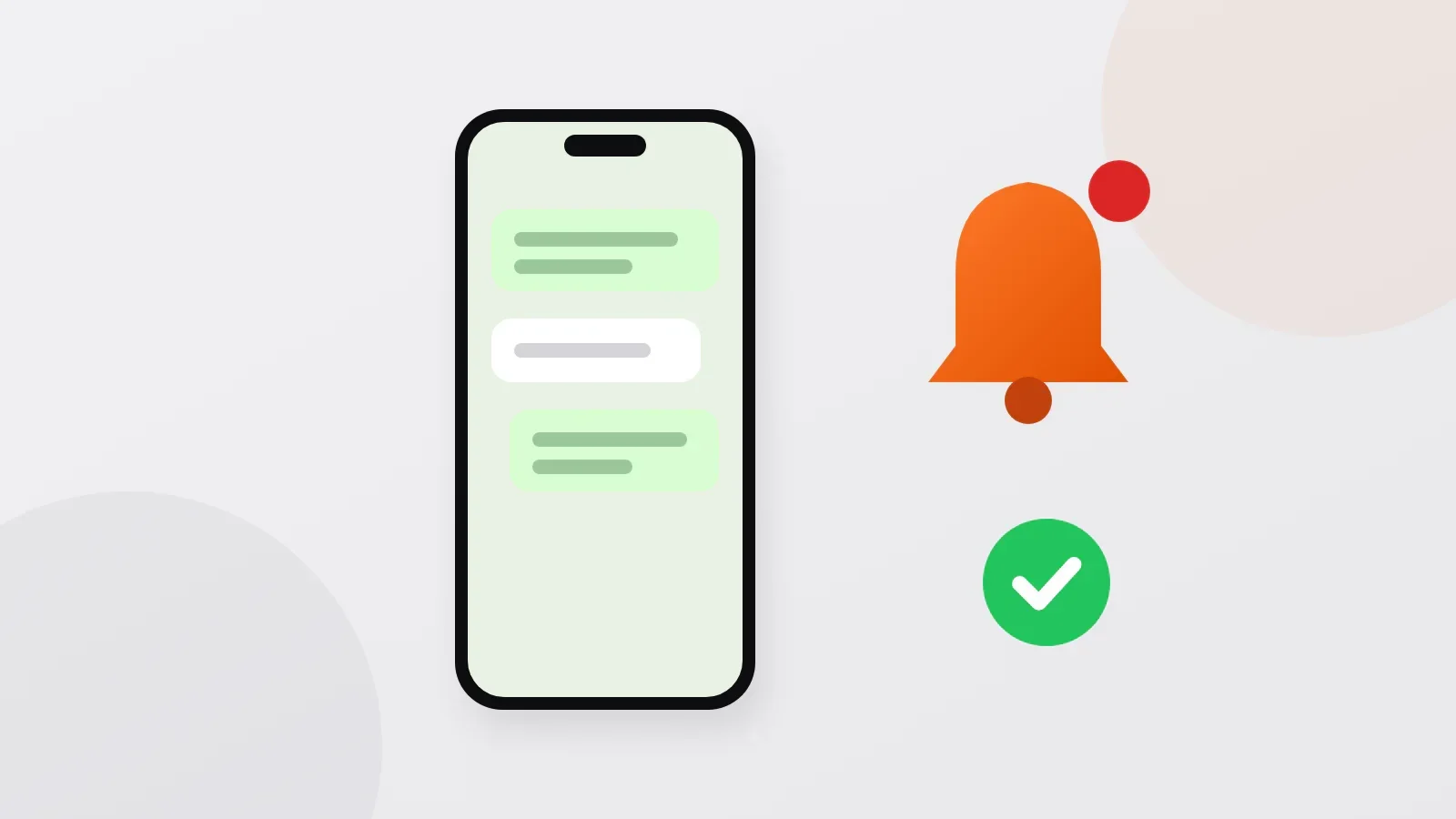
Send a friendly note two or three days before the due date, a short one on the day and a firmer one after it; each should give the amount, the date and how to pay. Write to the customer only, in the daytime, and never threaten or shame anyone. Eight ready templates for WhatsApp or SMS follow.
When to send a reminder
| When | Goal | Tone |
|---|---|---|
| 2–3 days before the due date | prevent forgetting | friendly, light |
| on the due date | ask to pay today | short, neutral |
| 1–3 days after | find out what happened | polite, direct |
| about a week after | agree on a date or a plan | firm, looking for a solution |
| two weeks or more after | last notice before stopping credit | calm, formal |
One message at each step is enough. A late payer has often simply forgotten, which is why the reminder before the due date is the most useful one: it arrives while paying on time is still possible. Stop as soon as the customer pays or agrees a plan, and thank them.
What every reminder should include
- The customer's name, and the name of your shop. People save numbers badly, so sign the message.
- The amount, and if it helps, what it was for: "groceries from 25 October".
- The date: when the payment is due, or when it was due.
- How to pay: cash at the shop, a bank transfer with the details, or a local payment method. In Brazil, for example, a Pix key: Pix works 24 hours a day and is free for individuals, according to the central bank.
- An easy way to answer, such as "reply here if anything is wrong". If the customer says they already paid, check your book together; a list of every purchase and payment with dates usually settles it.
Keep it to two or three sentences that fit on a phone's lock screen, and write in the language your customer uses. If you ever send a formal written demand, check the local requirements. In Brazil, for example, every collection document given to a consumer must show the supplier's name, address and tax number, CPF or CNPJ (Consumer Defense Code, art. 42-A).
8 templates for WhatsApp or SMS
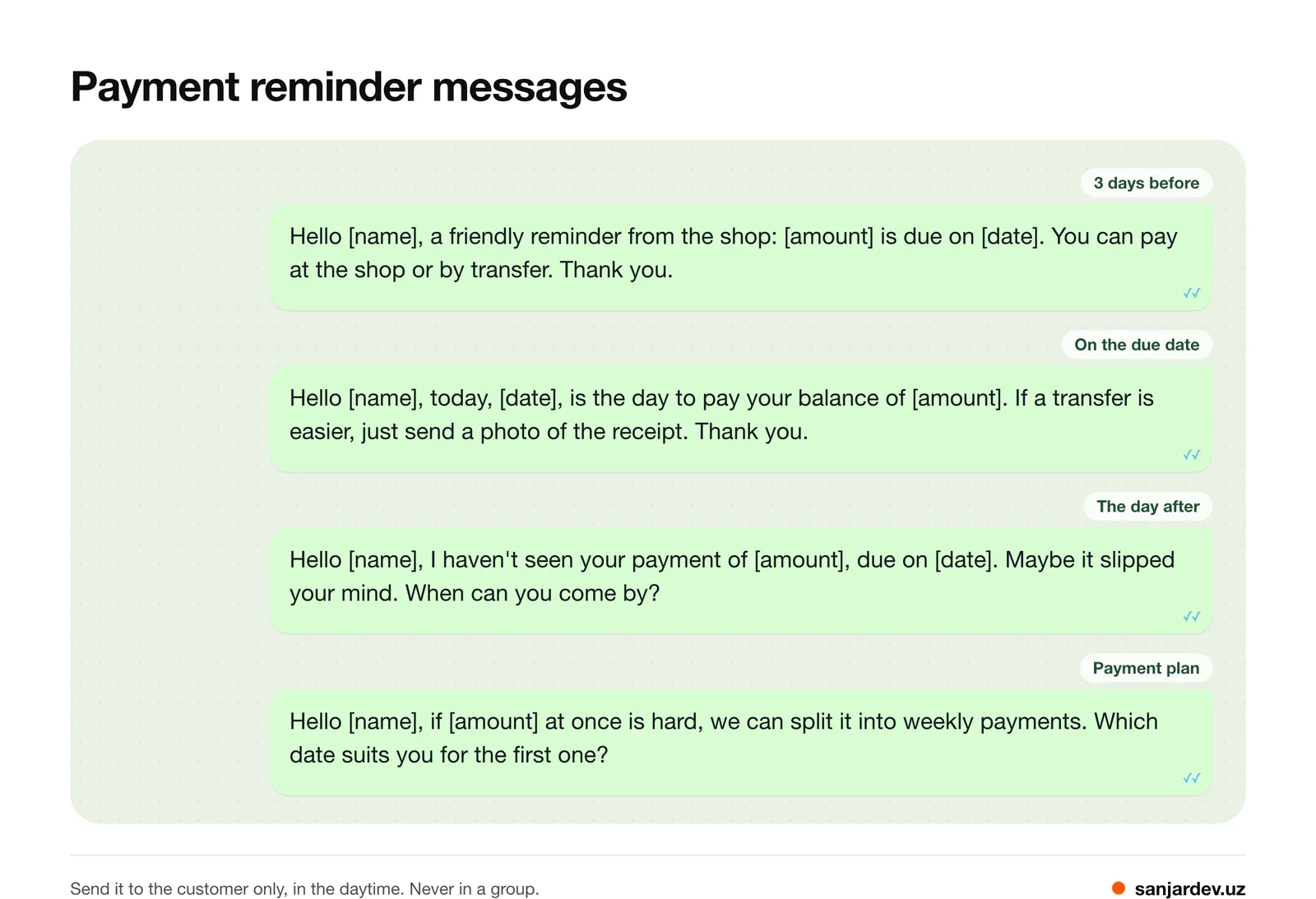
Replace the words in brackets. The sign-off "[shop]" is your shop's name.
- Three days before: "Hello [name], a friendly reminder from the shop: [amount] is due on [date]. You can pay at the shop or by transfer. Thank you. — [shop]"
- On the due date: "Hello [name], today, [date], is the day to pay your balance of [amount]. If a transfer is easier, just send a photo of the receipt. Thank you. — [shop]"
- The day after: "Hello [name], I haven't seen your payment of [amount], due on [date]. Maybe it slipped your mind. When can you come by? — [shop]"
- A week after: "Hello [name], your balance of [amount] has been due since [date]. Please pay it this week, or tell me which day works for you. — [shop]"
- Offering a payment plan: "Hello [name], if [amount] at once is hard, we can split it into weekly payments. Which date suits you for the first one? — [shop]"
- Confirming the plan: "Hello [name], to confirm what we agreed: [amount] in three payments of [part], on [date 1], [date 2] and [date 3]. Thank you for sorting this out. — [shop]"
- Thanks after a payment: "Hello [name], I received [amount], thank you. Your balance is now [balance]. — [shop]"
- Final notice: "Hello [name], your balance of [amount] has been overdue since [date] and we have no plan yet. Until it is paid, I can only sell to you for cash. I'm happy to agree a plan. — [shop]"
Every template names a fact and asks for one action. None of them mentions other people, guesses why the customer has not paid, or warns of consequences you cannot or will not carry out.
What not to do
Debt collection rules differ by country, and some of the laws below apply only to banks or collection agencies, but together they show where regulators draw the line. Treat them as the standard for your shop too.
- Do not make the debt public. No lists on the wall, in a neighbourhood group or on social media. Brazil's Consumer Defense Code says a customer who owes money must not be exposed to ridicule or embarrassment when you collect (art. 42). In Mexico, the consumer agency's rules for businesses that regularly give credit, and for the collectors working for them, ban posters or notices in public view that mention a customer's debt (Acuerdo A/002/2015, art. 5).
- Do not contact relatives, neighbours or the employer. In Russia, a creditor may contact family members, neighbours or other people about a debt only if both the debtor and that person agree (Federal Law 230-FZ, art. 4). In Colombia, anyone collecting a debt may not contact personal references (Law 2300 of 2023, art. 4). In Türkiye, the data protection board fined a company 85,000 lira after a debt message reached the phones of the debtor's company (decision 2023/78).
- Do not threaten or mislead. No threats of the police, prison or court that you do not mean. Brazil makes threats and false statements in debt collection a crime (Consumer Defense Code, art. 71), and Russian law forbids misleading a debtor about court or criminal consequences (230-FZ, art. 6).
- Do not write at night or too often. In Russia, messages about an overdue debt are not allowed on working days between 22:00 and 8:00, or on weekends and holidays between 20:00 and 9:00, and not more than twice a day, four times a week or 16 times a month (230-FZ, art. 7). In Colombia, collection contacts are allowed Monday to Friday from 7 a.m. to 7 p.m. and on Saturdays from 8 a.m. to 3 p.m., never on Sundays or holidays, and at most once a day (Law 2300 of 2023, art. 3). A good rule anywhere: daytime, weekdays, one message.
- Do not message people who did not agree to it. WhatsApp's business policy allows a business to contact people only if they gave it their number and agreed to receive its messages, and it must stop when they ask. When you first sell on credit, ask: "Can I send you a reminder on WhatsApp?"
If the customer does not answer
- Wait two or three days after a reminder before the next one.
- Call once, during the day, or talk to them in person at the shop, where nobody else can hear.
- Offer a payment plan, template 5, and confirm it in writing, template 6.
- Stop new credit until the debt or the plan is on track.
- Send the final notice, template 8.
- If the amount is worth it, ask a local lawyer, mediation service or consumer office about formal steps. Keep your records, your messages and the customer's confirmations.
A customer who answers, even to say "not this week", is easier to deal with than one who goes quiet, so make answering easy: no blame, a clear amount and a choice of dates. The rules that prevent most of these situations are in selling on credit: is it worth it, and a good record starts with the customer credit book.
FAQ
How do I politely remind someone to pay me?
Name the amount and the date, ask for one simple action, and leave room for an answer: "Hello Ana, a friendly reminder: 14.00 is due on Friday. Thank you." Send it privately, before the due date if you can.
How do I write a payment reminder on WhatsApp?
Use a short message with the customer's name, the amount, the due date and how to pay, and sign it with your shop's name. Send it only to customers who agreed to get messages from you on WhatsApp, and stop if they ask you to.
How do I ask for money owed nicely, without pestering?
Keep a calm rhythm: once before the due date, once on the day, then about once a week, always in the daytime and in private. Some countries set legal limits; in Russia, for example, no more than twice a day, four times a week and 16 times a month for messages about an overdue debt.
What if the customer is a friend or a relative?
Use the same messages and the same rules. Presenting the reminder as the shop's routine, which everyone gets, takes the personal edge off: "I send this to all customers before the due date." Keep it private, as with anyone else.
How Daftio helps
In Daftio, the app we develop for Android, the Remind button on a customer's card prepares a message in the customer's language with the amount and the due date: one version before the due date, one when the debt is overdue and one without a date. You can edit it and send it through WhatsApp, SMS or Telegram; you always tap Send yourself, so nothing goes out without you. In Brazil, it can add a Pix copy-and-paste code for the balance. Without a subscription, you remind customers one by one; Daftio Pro, a yearly subscription with a 7-day trial, adds your own reminder text and reminding all overdue customers one after another. Daftio does not send messages automatically or collect debts. Daftio on Google Play.
Sources
- Lei nº 8.078/1990, Código de Defesa do Consumidor, arts. 42, 42-A and 71 — Câmara dos Deputados, Brazil, 1990 (updated text)
- Federal Law No. 230-FZ on returning overdue debts, arts. 4, 6 and 7 — ConsultantPlus, Russia, 2016 (text as of 2026)
- Ley 2300 de 2023 — Secretaría General del Senado, Colombia, 2023
- Acuerdo A/002/2015, disposiciones en materia de despachos de cobranza — Procuraduría Federal del Consumidor, Diario Oficial de la Federación, Mexico, 2015
- Decision 2023/78 on a debt message sent to a company's phone numbers — Personal Data Protection Board (KVKK), Türkiye, 2023
- WhatsApp Business Messaging Policy — WhatsApp, 2026
- Pix — Banco Central do Brasil, 2026
Written by Sanjar Jabborov, developer of Daftio. Checked against the laws and policies cited above. Updated on 14 November 2026. This is general information, not legal advice: debt collection rules differ by country and change.