How to Keep a Customer Credit Book (Free Printable Page)
How to keep a customer credit book in a shop: what to write for every entry, how to record payments and balances, a monthly check and a free printable page.
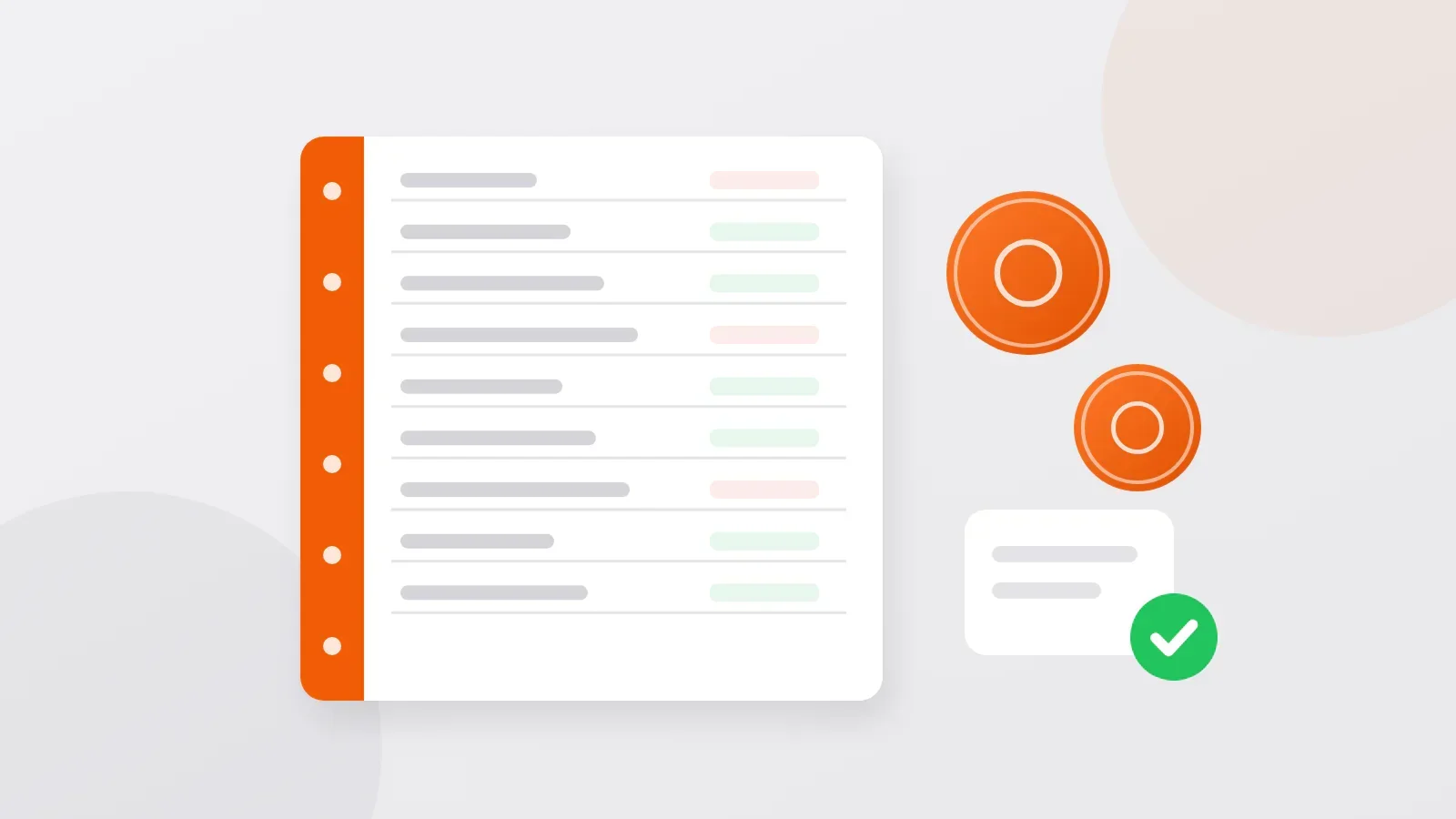
A customer credit book is where a shop writes down what regular customers take now and pay for later. For every entry, write the date, the customer's name and phone, what they took, the amount, the agreed due date and a confirmation; record every payment the same way and keep a running balance, so you always know who owes what. Below is a free printable page with these columns and how to use it.
What a credit book is, and what people call it
In many countries, regular customers take bread, rice or phone credit today and pay at the end of the week or on payday. The notebook where the shop records this is the credit book, also called a debt book or a customer ledger. The habit is the same everywhere, and only the name changes:
| Where | What people call it |
|---|---|
| Brazil | caderneta de fiado, selling "fiado" |
| Mexico and much of Latin America | libreta de fiados |
| Türkiye | veresiye defteri |
| Arab countries | daftar al-duyun (دفتر الديون) |
| Uzbekistan | qarz daftar; a sale on credit is "nasiya" |
| Russia and Russian speakers | dolgovaya tetrad (долговая тетрадь) |
The problems are the same everywhere too: a page goes missing, nobody remembers agreeing to an amount, a customer says they already paid. A well-kept book prevents most of them.
What to write for every entry
| Column | What to write | Why it matters |
|---|---|---|
| Date | the day the goods were taken or the money was paid | settles "when was that?" |
| Customer | full name, and a detail if names repeat ("Ana, the teacher") | two people with one name is a classic mix-up |
| Phone | a number you have checked once | you need it for reminders |
| What was taken | items and quantities ("rice 5 kg, oil 1 l") | people remember goods better than sums |
| Amount | the price on that day | prices change, the book keeps what was agreed |
| Paid | money received, if any | partial payments are normal |
| Balance | what this customer owes after this line | the number you need at the counter |
| Due date | an exact day agreed with the customer | "later" is not a date |
| Signature | the customer's initials or signature | an entry the customer confirmed is much harder to dispute |
If a customer will not sign at the counter, a short message right after the purchase does the same job: "Today: rice 5 kg and oil, 7.80, to pay by 15 November." Keep their reply.
Never erase a mistake or tear out a page. Cross the wrong amount out with one line, write the correct one next to it and initial it. The page should show what happened, including the corrections.
One page per customer or one list by date
There are two common ways to organize the book:
- A page per customer. Each regular has their own page with the full history and the current balance. You can show a customer their page without revealing anyone else's. It works well for a few dozen customers, but busy pages fill up fast and you need an index at the front.
- One list by date. Every purchase and payment goes on the next free line, whoever it is. It is the fastest way at a busy counter, but to find one customer's balance you have to look for their previous line.
Many shops combine the two: a quick list at the counter during the day, copied to the customers' pages in the evening. The printable page below works both ways: as a list for the month, or as a page for one customer.
How to record payments and keep a running balance
- Find the customer's last line and read the balance.
- Write the new purchase: date, what was taken, the amount and the due date.
- Add the amount to the old balance and write the new balance.
- When the customer pays, write a line with the date and the sum in Paid, and subtract it from the balance.
- Read the new balance aloud and ask the customer to initial the line.
Here is one customer over three weeks:
| Date | What was taken | Amount | Paid | Balance | Due date |
|---|---|---|---|---|---|
| 25 Oct | groceries | 34.00 | 34.00 | 10 Nov | |
| 3 Nov | payment | 20.00 | 14.00 | ||
| 12 Nov | bread and milk | 4.50 | 18.50 | 19 Nov |
On 14 November, Maria owes 18.50. Apply payments to the oldest purchases first: the 20.00 she paid went to the groceries, so 14.00 of her balance was due on 10 November and is late, while the new 4.50 is not due until 19 November. Keeping to "oldest first" makes it clear which part is overdue.
If a customer pays more than they owe, write the balance as a negative number, which means you owe them, or give the change back. Do not let it disappear.
Limits, due dates and the monthly check
Decide a maximum balance for each customer before the first sale, for example what they usually buy in one or two weeks, and write it on their page. Agree an exact due date for every purchase, not "when I get paid". The other rules that keep losses small are in selling on credit: is it worth it.
Once a month, close the book:
- Add up all the balances. The total is the money your shop has lent out.
- Mark every customer whose due date has passed.
- Remind them privately. Polite templates are in payment reminder messages.
- When a balance reaches zero, write "paid" with the date and your initials.
- Start the new month with each customer's balance carried forward, and ask them to confirm it.
- Photograph the pages.
Keep the book safe and private
The credit book is your only proof of what people owe you, and it is full of personal information. Three habits help:
- Keep it out of customers' sight, and never let one customer read another's page.
- Photograph the pages after the monthly check and keep the photos somewhere other than the shop.
- Never post a list of debtors on the wall, in a group chat or on social media. Apart from shaming people, it can break consumer or privacy laws. Brazil's Consumer Defense Code says a customer who owes money must not be exposed to ridicule or embarrassment when you collect (art. 42). In Türkiye, the data protection board ruled in 2026 that posting residents' debts in the common areas of apartment buildings has no legal basis and must stop (principle decision 2026/348). In Saudi Arabia, the rules of the personal data law say that using people's data for commercial purposes, or publishing it, is not "personal use", so the law applies to a shop's records.
Download the printable page
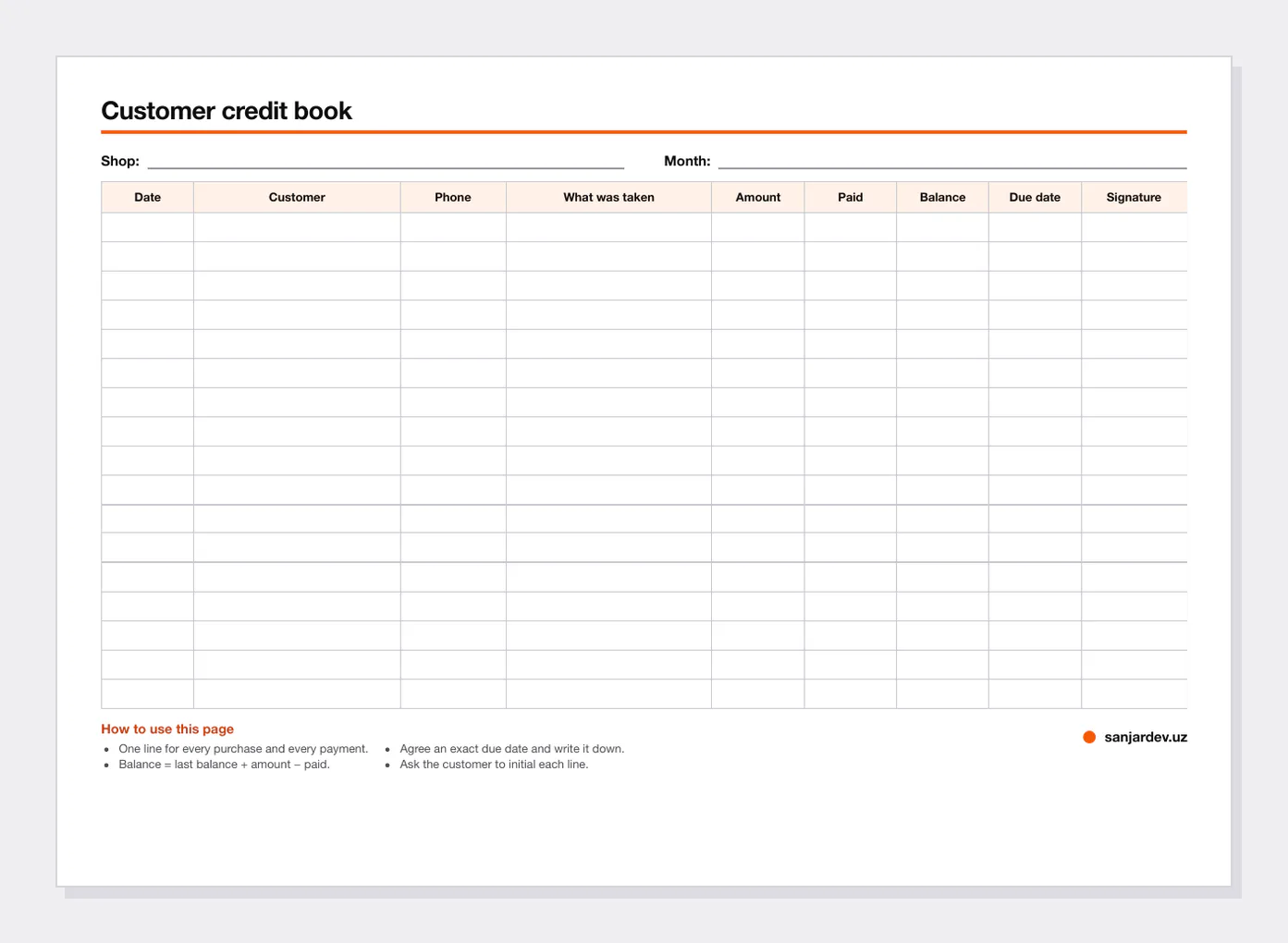
Download the printable credit book page (PDF)
The page prints on one A4 sheet in landscape. If your printer uses Letter paper, choose "fit to page". Write the shop name and the month at the top, then use one line for every purchase and every payment. In the Balance column, write the customer's total after that line. Print several copies and keep them in a folder or staple them into a notebook, so the months stay in order.
When paper stops working
A paper book is enough for a small shop with a few dozen regulars and one person at the counter. It starts to cost you money when:
- finding what someone owes takes more than a minute;
- customers dispute amounts and you cannot show the history quickly;
- several people write in the book and the handwriting and the arithmetic differ;
- you forget to remind people, because nothing tells you who is late;
- the book is the only copy, and one spilled tea or one lost bag would wipe out the record.
The next step can be a spreadsheet, such as our free customer debt tracker template, or an app on your phone.
FAQ
What is a credit book?
It is a notebook or file where a shop records goods sold on credit to customers and the payments they make, with each customer's balance. People also call it a debt book, a credit ledger or a customer ledger.
Is a credit book the same as a ledger book?
In a small shop, yes: "ledger book" usually means a book with a page or a line per customer showing what they owe. Accountants use "ledger" more widely, for all of a business's accounts, but for customer credit the two names mean the same thing.
What does a store ledger book look like?
Like the example above: columns for the date, the customer, what was taken, the amount, payments, the balance and the due date, with one line per purchase or payment. The printable page on this page follows the same layout.
What is customer credit?
It is when a business lets a customer take goods or services now and pay later. In a small shop it is usually informal, recorded in a credit book with a due date and the customer's initials. Do not confuse it with "store credit", which in many shops means a balance given back for a returned item.
How Daftio helps
Daftio, the app we develop, is a credit book on an Android phone. You pick a customer, type the amount and tap Debt or Payment; Daftio keeps the balance after every entry and shows the total owed, the overdue amount and how many customers are late on the main screen. You can set a due date and add a note or a voice note to an entry. The book works without internet, is backed up to your own Google Drive and can be locked with a PIN. Without a subscription, Daftio covers one shop and up to 30 customers; Daftio Pro, a yearly subscription with a 7-day trial, removes the limits and adds receipt photos, customer statements and CSV export. It runs on one phone, without shared access for staff. Daftio is available for Android: Daftio on Google Play.
Sources
- Lei nº 8.078/1990, Código de Defesa do Consumidor, art. 42 — Câmara dos Deputados, Brazil, 1990 (updated text)
- Principle decision 2026/348 on posting residents' debts in common areas — Personal Data Protection Board (KVKK), Resmî Gazete, Türkiye, 2026
- Implementing Regulation of the Personal Data Protection Law, art. 2 — Umm Al-Qura official gazette, Saudi Arabia, 2023
Written by Sanjar Jabborov, developer of Daftio. Checked against the laws cited above. Updated on 14 November 2026. This is general information, not legal advice: rules on debts and personal data differ by country.