Normal Blood Pressure by Age: Chart for Adults, Women and Men
Is 140/90 normal at 60? The adult blood pressure chart (ESH 2023 and AHA 2025), why the “100 plus your age” rule is a myth, and how home readings compare.
Short answer: for adults of any age, blood pressure below 120/80 mmHg is normal (the European chart calls it “optimal”). Hypertension starts at 140/90 measured in a clinic under the European guideline, and at 130/80 under the American one. These numbers do not rise with age. What rises with age is the chance of crossing them.
Below is the chart doctors actually use, what changes as we get older, and how to read numbers you take at home.
Blood pressure chart for adults
Blood pressure is written as two numbers. The top one (systolic) is the pressure when the heart contracts, the bottom one (diastolic) is the pressure between beats. 128/82 means 128 systolic and 82 diastolic, in millimetres of mercury (mmHg).
Two charts are used around the world. Most European countries, and many others that follow European guidance, use the classification of the European Society of Hypertension (ESH 2023). The United States uses the guideline of the American Heart Association and the American College of Cardiology (AHA/ACC), updated in 2025 with the same categories as in 2017.
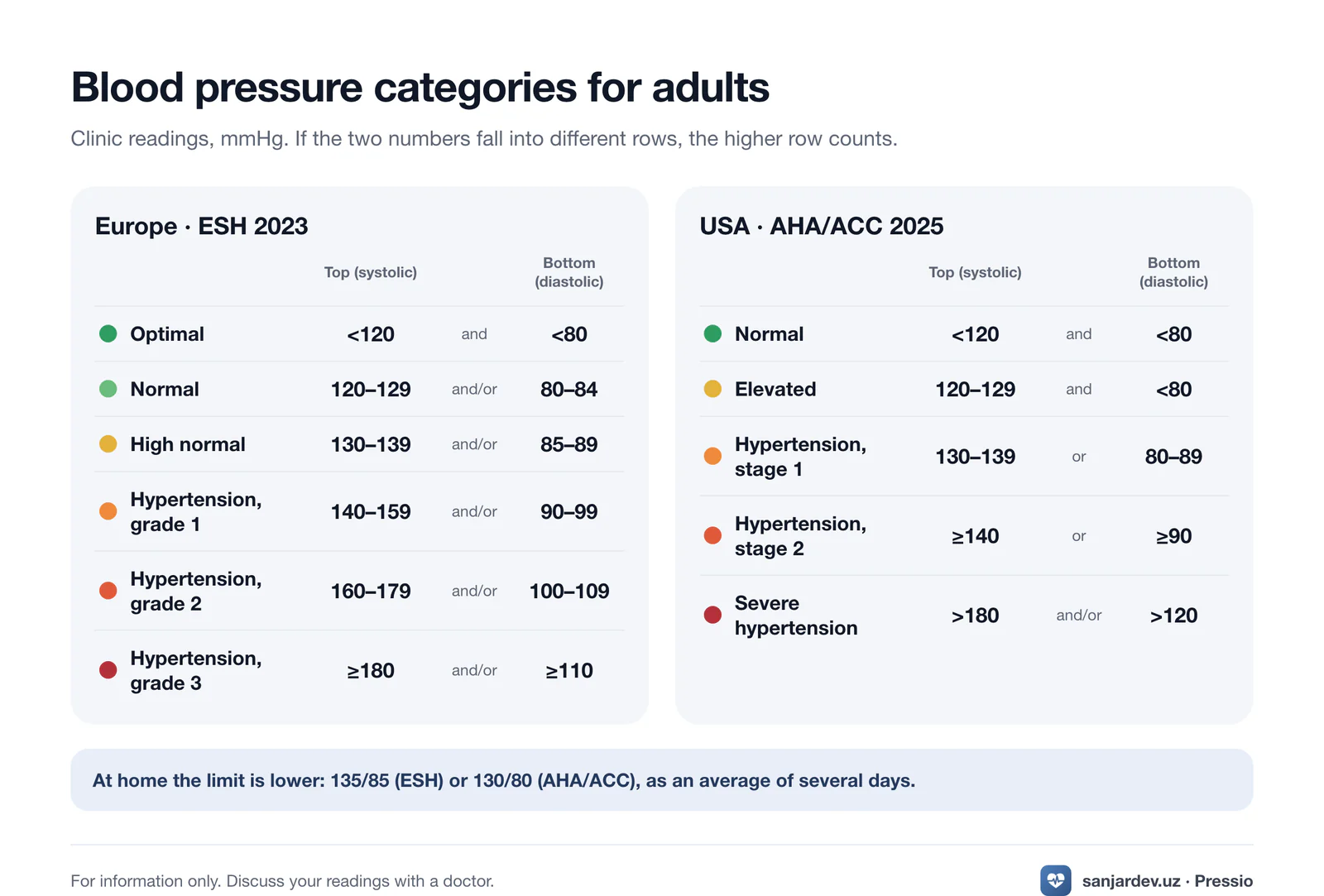
ESH 2023, readings taken at a clinic (mmHg)
| Category | Top number (systolic) | Bottom number (diastolic) | |
|---|---|---|---|
| Optimal | below 120 | and | below 80 |
| Normal | 120–129 | and/or | 80–84 |
| High normal | 130–139 | and/or | 85–89 |
| Hypertension, grade 1 | 140–159 | and/or | 90–99 |
| Hypertension, grade 2 | 160–179 | and/or | 100–109 |
| Hypertension, grade 3 | 180 or higher | and/or | 110 or higher |
AHA/ACC 2025 (mmHg)
| Category | Top number (systolic) | Bottom number (diastolic) | |
|---|---|---|---|
| Normal | below 120 | and | below 80 |
| Elevated | 120–129 | and | below 80 |
| Hypertension, stage 1 | 130–139 | or | 80–89 |
| Hypertension, stage 2 | 140 or higher | or | 90 or higher |
| Severe hypertension | higher than 180 | and/or | higher than 120 |
When the two numbers fall into different rows, the higher row counts. A reading of 150/85, for example, is grade 1 hypertension by ESH and stage 2 by AHA/ACC.
The newest European document, the ESC 2024 guideline of the European Society of Cardiology, groups the middle ranges differently: below 120/70 is “non-elevated”, from 120/70 up to 139/89 is “elevated blood pressure”, and 140/90 or higher is hypertension. The line for hypertension is the same as in ESH.
Why the American line is lower
ESH and AHA/ACC look at the same research. The American guideline calls 130–139/80–89 “stage 1 hypertension” so that people start changing habits earlier; in the European chart the same readings are “high normal” or, with a bottom number of 80–84, even “normal”. Both recommend lifestyle changes in this range, and in both, whether a person needs medication depends on their overall heart and stroke risk. That decision is made by a doctor, not by the label in a table.
Does normal blood pressure depend on age?
No. For adults, the same numbers apply at 25, 60 and 85.
You may have seen tables that say 140/90 is normal at 60, or the rule “normal top number = 100 plus your age”. They come from old textbooks and describe what was common in older people, not what is healthy for them. Current guidelines (ESH 2023, ESC 2024, AHA/ACC 2025) use one set of numbers for all adults.
What does change with age:
- The top number tends to climb. Arteries become stiffer, so systolic pressure rises while diastolic may stay the same or even fall. A high top number with a normal bottom one, called isolated systolic hypertension, is the most common type after 60.
- High blood pressure becomes far more common. In the United States national survey of 2021–2023, it affected 23% of adults aged 18–39, 53% of those aged 40–59 and 72% of those aged 60 and over.
- Treatment goals can be more individual. For people over 65, and especially over 80, doctors may aim for a slightly different target to avoid dizziness and falls. That is a treatment decision for someone already diagnosed, not a new definition of “normal”.
- Feeling dizzy when you stand up becomes more common. If it happens to you, tell your doctor: they may check your blood pressure while you are standing.
Normal blood pressure for women and men
The chart is the same for women and men. What differs is how often blood pressure is high: in the same US survey, 51% of men and 45% of women had hypertension. In women, blood pressure tends to rise after menopause.
Pregnancy has its own thresholds and warning signs. If you are pregnant, follow the advice of your midwife or doctor rather than the general chart.
Children and teenagers
Children are judged by percentiles for their age, sex and height, not by the adult chart. In the American pediatric guideline, adult-style thresholds apply from age 13. If you are worried about a child’s readings, talk to a pediatrician.
What counts as low blood pressure
There is no single official threshold. Readings around 90/60 or lower are usually called low. Low blood pressure matters mainly when it causes symptoms such as dizziness, blurred vision or fainting. If that happens, especially if you take blood pressure medication, tell your doctor.
Home readings have their own thresholds
At home most people are calmer than in a clinic, so their readings are lower. That is why the limit for home measurements is lower too:
- ESH 2023 and ESC 2024: hypertension if the average of home readings is 135/85 or higher. The same limit is used by the French health authority (HAS) and the Korean Society of Hypertension.
- AHA/ACC: the home value that matches stage 1 is 130/80.
“Average” here means a series, not one measurement: usually two readings in the morning and two in the evening for several days. How to set this up is explained in when to measure blood pressure, and a ready-made sheet is in our printable blood pressure log.
The gap between the two places has names. White coat hypertension means high readings at the clinic and normal ones at home. Masked hypertension is the opposite: normal at the clinic, high at home. Both are reasons doctors increasingly ask patients to measure at home.
One high reading is not a diagnosis
Blood pressure changes from minute to minute. Talking or a full bladder can each add about 10 mmHg, a cuff that is too small up to 10, and a cuff over a sleeve even more. Our guide on how to measure blood pressure at home lists these mistakes with numbers.
Hypertension is diagnosed from repeated measurements: several clinic visits, or a week of home readings averaged together. A single high number is a reason to measure again properly, not to panic.
When it can’t wait: if your reading is 180/120 or higher and you have chest pain, shortness of breath, back pain, numbness, weakness, changes in vision or difficulty speaking, call your local emergency number. What to do with a very high reading without symptoms is explained in blood pressure 180/120: what to do.
How Pressio helps
We make Pressio, a blood pressure diary for iPhone and Android. You choose the ESH 2023 or AHA/ACC table, and each reading you enter gets its category in color, in a word and with an icon. The home screen shows morning and evening averages for the last 7 days, and the report for your doctor collects them in one PDF.
Pressio does not measure blood pressure: you enter the numbers from your own monitor. It does not diagnose either. It helps you bring clean, complete data to your doctor.
Sources
- ESH 2023 Guidelines for the management of arterial hypertension — Journal of Hypertension, 2023
- 2024 ESC Guidelines for the management of elevated blood pressure and hypertension — European Heart Journal, 2024
- 2025 AHA/ACC High Blood Pressure Guideline: top things to know — American Heart Association
- Hypertension prevalence among adults, 2021–2023 (NCHS Data Brief 511) — CDC
- Hypertension: fact sheet — World Health Organization, 2025
Written by Sanjar Jabborov, developer of Pressio. Checked against the ESH 2023, ESC 2024 and AHA/ACC 2025 guidelines. Updated on 13 November 2026. This article is for information only and does not replace advice from a doctor.