How to Measure Blood Pressure at Home Correctly: Step by Step
How to take an accurate blood pressure reading at home: the right monitor and cuff size, how to sit, which arm to use, and 7 mistakes that add up to 50 mmHg.
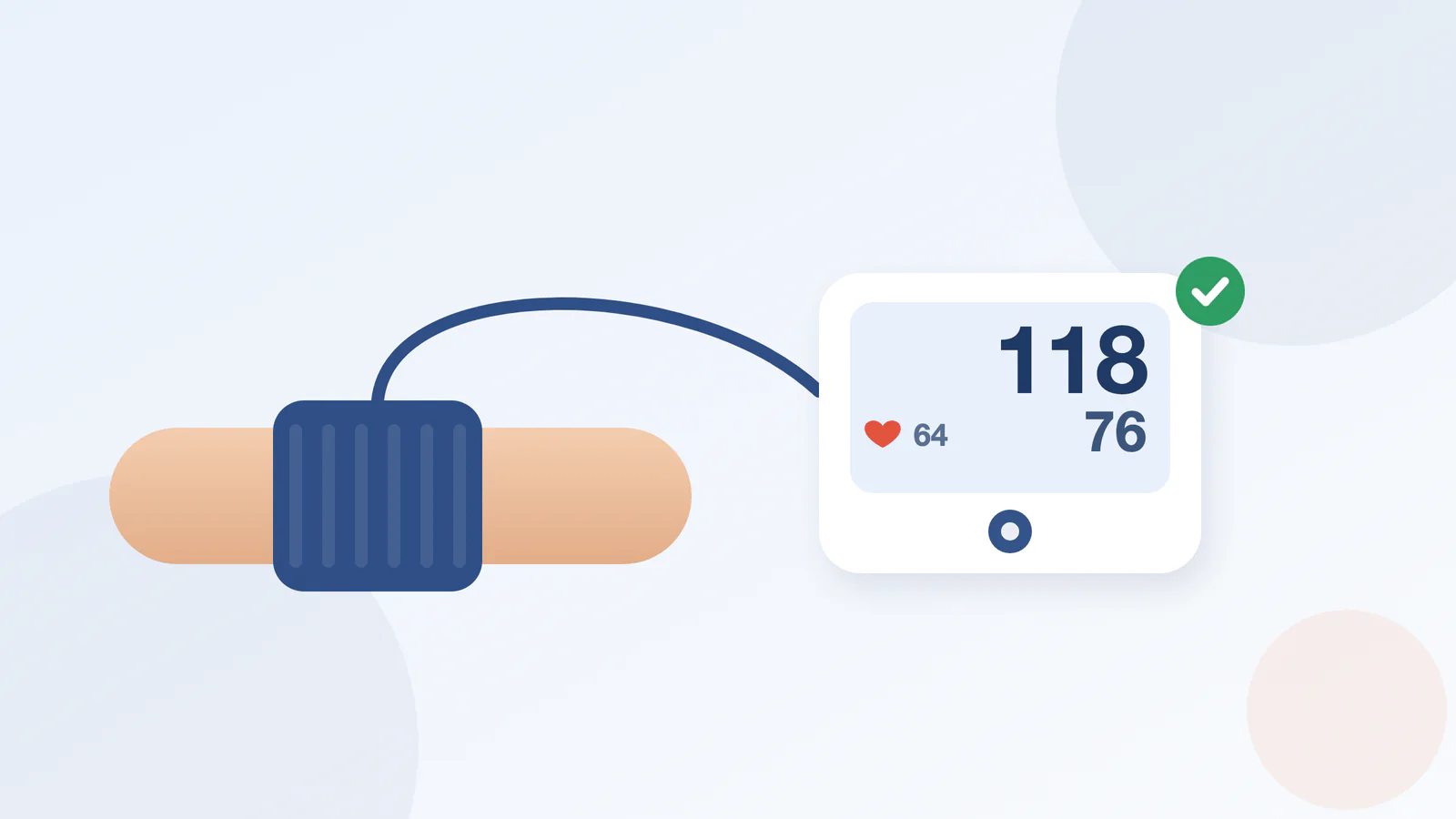
A home reading is only as good as the way it was taken. Talking during the measurement adds about 10 mmHg; a cuff put on over a sleeve can add up to 50. These are not rare slips — most people make at least one of them.
Here is how to measure so that the number on the screen reflects your real blood pressure, following the instructions of the American Heart Association (AHA) and the European Society of Hypertension (ESH).
What you need
An automatic upper-arm monitor that has been validated. Validation means the device was tested for accuracy against a reference method under an established protocol. Not every monitor on sale has passed such a test. You can check a model in the free international list STRIDE BP or, in the United States, at validatebp.org.
A cuff that fits your arm. A cuff that is too small gives readings that are too high; one that is too big, too low. Measure the circumference of your upper arm halfway between the shoulder and the elbow with a tape measure and compare:
| Arm circumference | Cuff size |
|---|---|
| 22–26 cm (8.7–10.2 in) | Small adult |
| 27–34 cm (10.6–13.4 in) | Adult |
| 35–44 cm (13.8–17.3 in) | Large adult |
| 45–52 cm (17.7–20.5 in) | Extra large (thigh) |
The range is usually printed on the cuff itself. If your arm is near the edge of the range, choose the cuff in which it sits more comfortably in the middle.
Before you measure
- No coffee, strong tea, energy drinks, smoking or exercise for 30 minutes before.
- Go to the toilet first: a full bladder adds 10–15 mmHg.
- Sit quietly for 5 minutes before the first reading. No phone, no TV news, no conversation.
How to sit
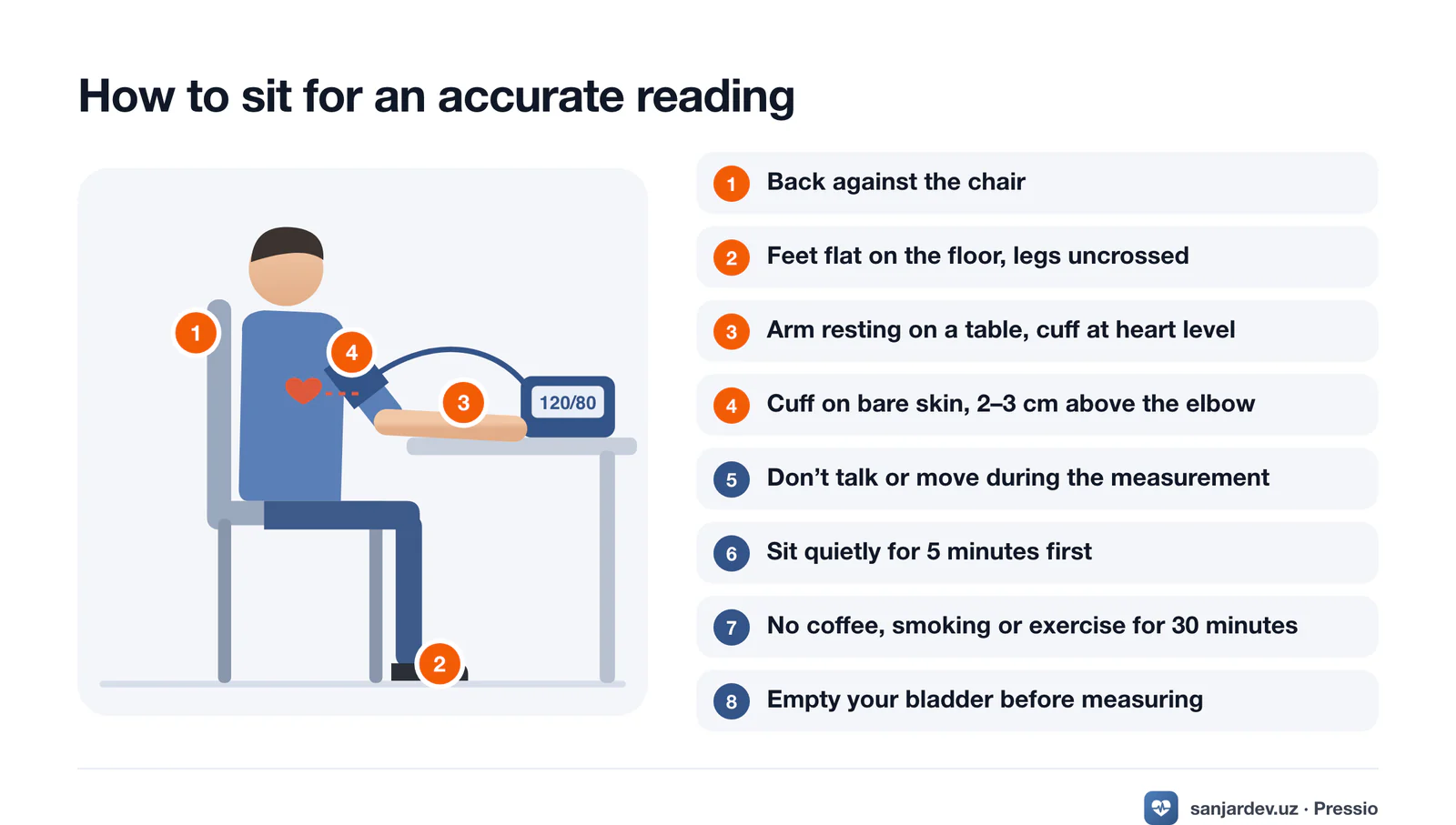
- Chair with a back. Lean against it: an unsupported back adds 6–10 mmHg.
- Feet flat on the floor, legs uncrossed. Crossed legs add 2–8 mmHg.
- Arm resting on a table with the cuff at the level of your heart, roughly in the middle of the chest. A hanging, unsupported arm adds up to 10 mmHg.
- Cuff on bare skin. Take your arm out of the sleeve or wear short sleeves; don’t roll a sleeve up, because a tight rolled sleeve squeezes the arm like a second cuff. The lower edge of the cuff should be 2–3 cm (about 1 inch) above the bend of the elbow, with the artery mark over the inside of the arm. It should be snug: two fingers fit under it, no more.
During the measurement
- Stay still and silent until the result appears. Talking or even listening actively adds about 10 mmHg.
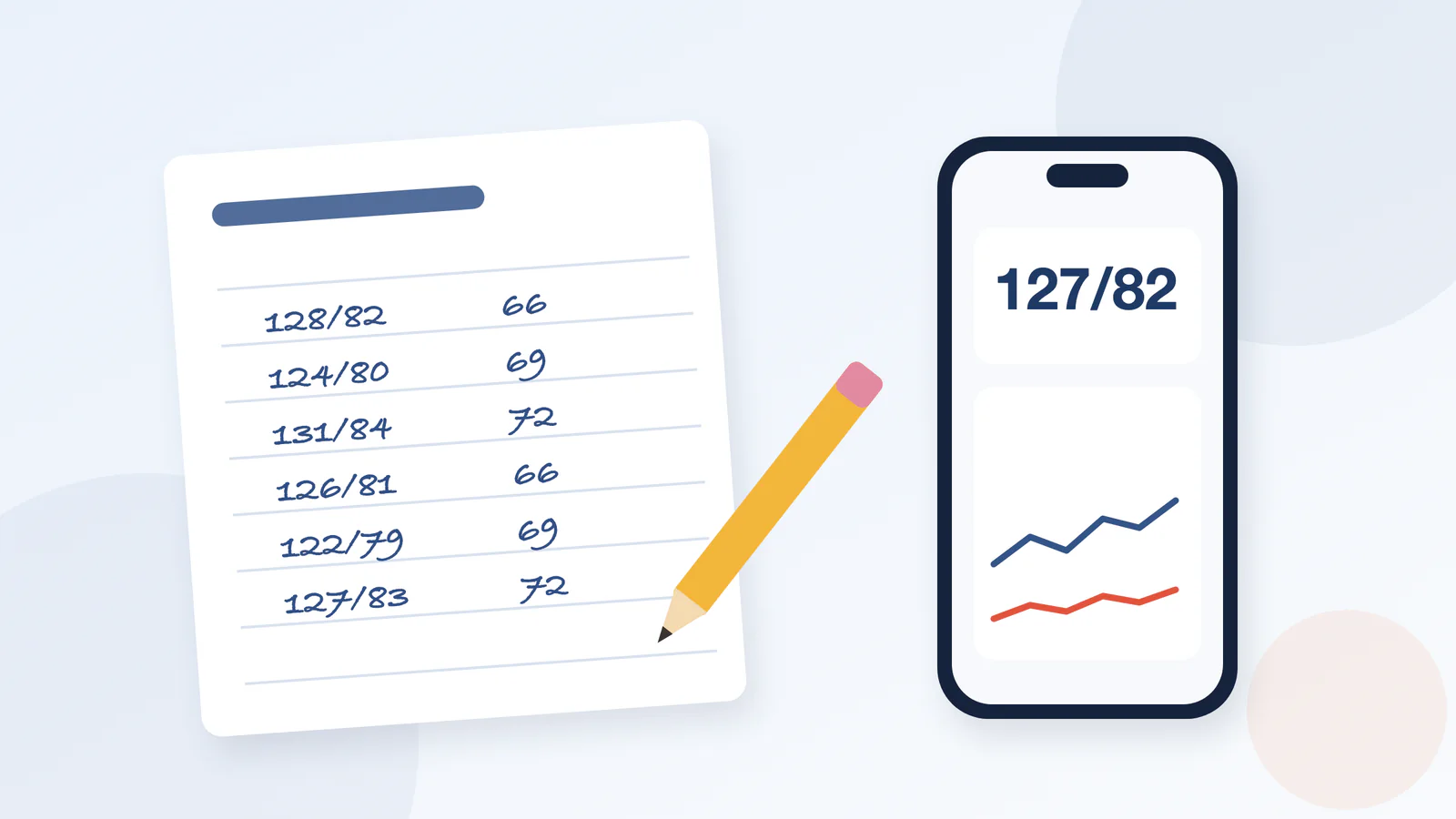
- Take two readings 1–2 minutes apart and write both down, together with the pulse, the date, the time and the arm. If the two readings differ a lot (more than 10 mmHg), take a third one.
- Record the numbers as they are. Don’t round them, don’t skip the “bad” ones and don’t repeat until you like the result: your doctor needs the real picture.
Which arm to use
The first time, measure both arms and compare. From then on, use the arm that gives the higher reading: that is the one doctors rely on. A small difference of a few mmHg is normal. If one arm is consistently higher by more than 10 mmHg, tell your doctor; a gap of more than 15 mmHg can be a sign of narrowed arteries.
There is no rule that the left or the right arm is “the correct one” — the comparison decides.
7 mistakes that change the reading
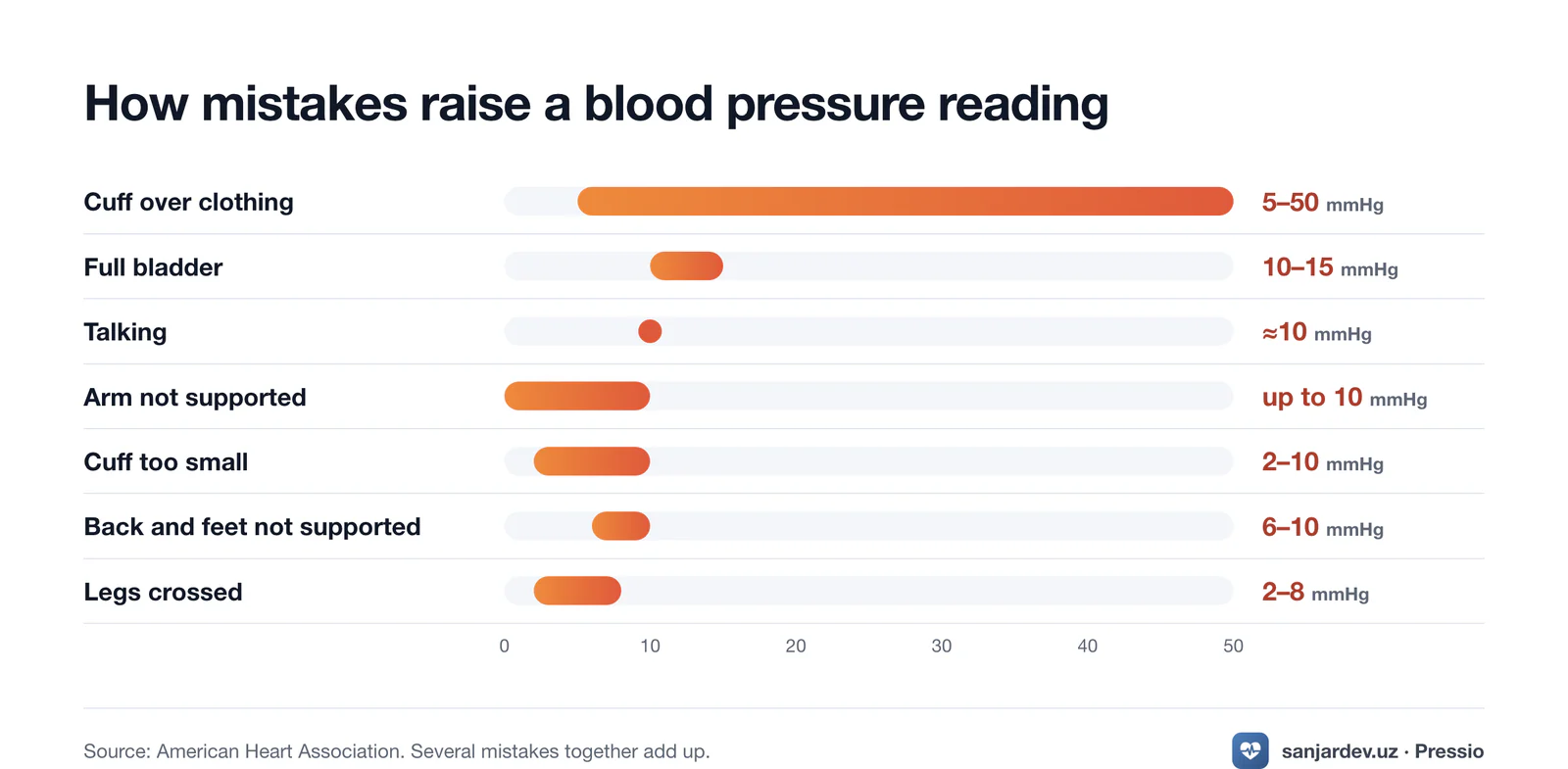
| Mistake | How much it can add |
|---|---|
| Cuff over clothing | 5–50 mmHg |
| Full bladder | 10–15 mmHg |
| Talking during the measurement | about 10 mmHg |
| Arm hanging without support | up to 10 mmHg |
| Cuff too small | 2–10 mmHg |
| Back and feet not supported | 6–10 mmHg |
| Legs crossed | 2–8 mmHg |
Figures from the American Heart Association. Several mistakes together add up.
Two more things distort home readings: measuring right after a meal, coffee or a walk upstairs, and measuring when you are cold, in pain or upset. If one of these happened, write it in the notes next to the reading.
Wrist monitors, smartwatches and phone apps
Doctors recommend upper-arm monitors. A wrist monitor is acceptable when an upper-arm cuff can’t be used, for example when the arm is too large for any available cuff. In that case keep the wrist exactly at heart level during the measurement, because a few centimetres higher or lower change the result.
Smartwatches and rings that estimate blood pressure without a cuff are not yet recommended for diagnosing or treating hypertension. And no phone can measure blood pressure with its camera or a fingertip: apps that promise this give numbers that have nothing to do with your real pressure.
Sitting, lying or standing
The standard home measurement is seated. Readings taken lying down or standing differ and should not be mixed into the same series. If you feel dizzy when you stand up, tell your doctor: they may ask you to measure after standing for 1 and 3 minutes and to write those readings separately.
How often to measure
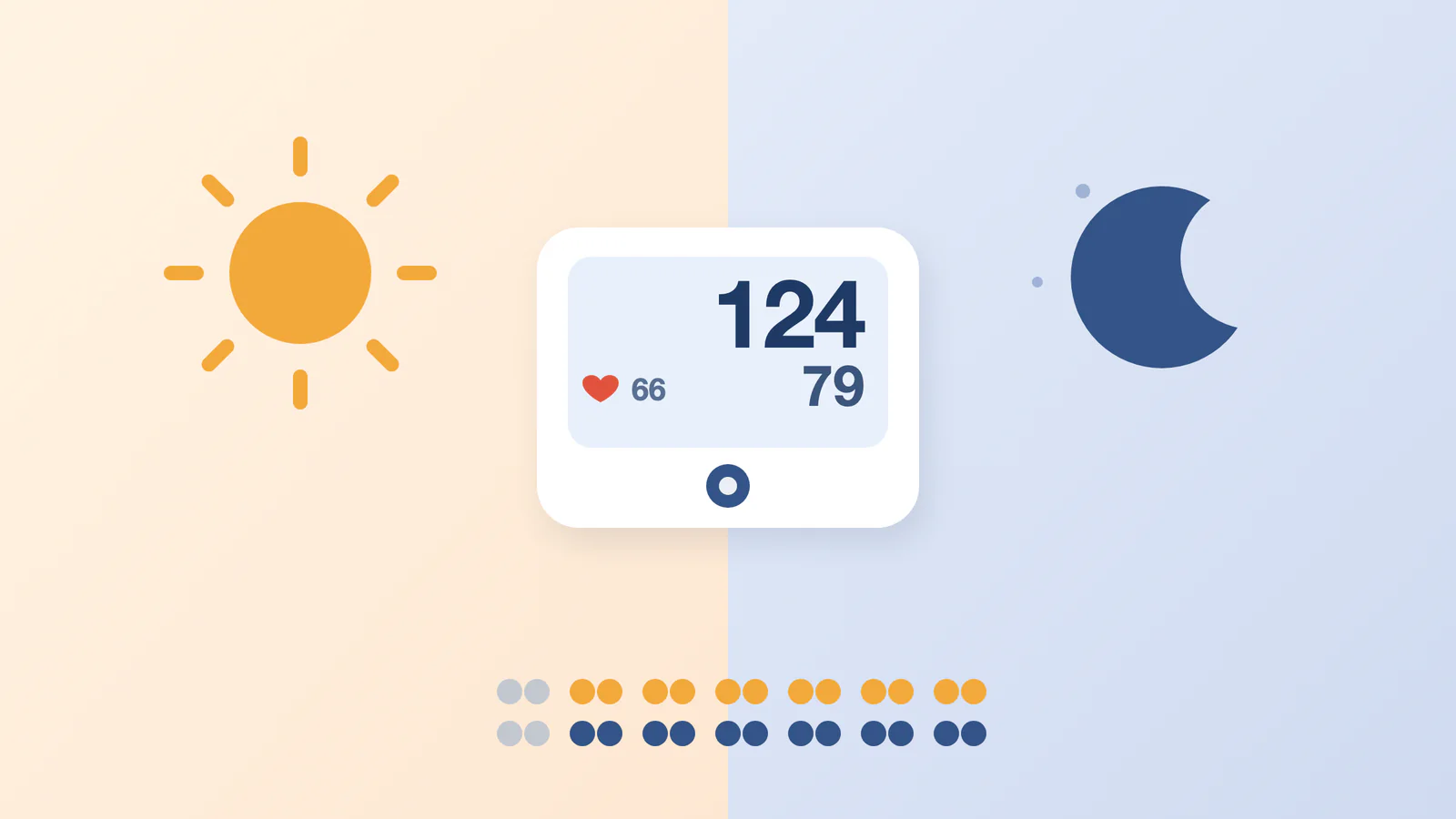
It depends on why you are measuring. Before a doctor’s visit, the usual scheme is 7 days, two readings in the morning and two in the evening. When treatment is stable, a few days of readings now and then may be enough — ask your doctor. The details are in when to measure blood pressure, and you can use our printable blood pressure log to write the numbers down.
How Pressio helps
In Pressio, the diary we develop for iPhone and Android, you enter a reading with a big keypad that jumps from the top number to the bottom one and to the pulse by itself, and readings taken a few minutes apart are combined into one series with its average. You can note the arm and the position for each reading. Pressio does not measure blood pressure — you take it with your own monitor, the way described above.
Sources
- Measurement of blood pressure in humans: a scientific statement from the AHA — Hypertension, 2019
- ESH 2023 Guidelines for the management of arterial hypertension — Journal of Hypertension, 2023
- STRIDE BP: validated blood pressure monitors
- Validated device listing — American Medical Association
Written by Sanjar Jabborov, developer of Pressio. Checked against AHA and ESH recommendations on blood pressure measurement. Updated on 13 November 2026. This article is for information only and does not replace advice from a doctor.