Payment Receipt Template for Contractors (Free Printable)
A free printable payment receipt for deposits and final payments: what to write on it, the amount in words, how it differs from an invoice and how long to keep it.
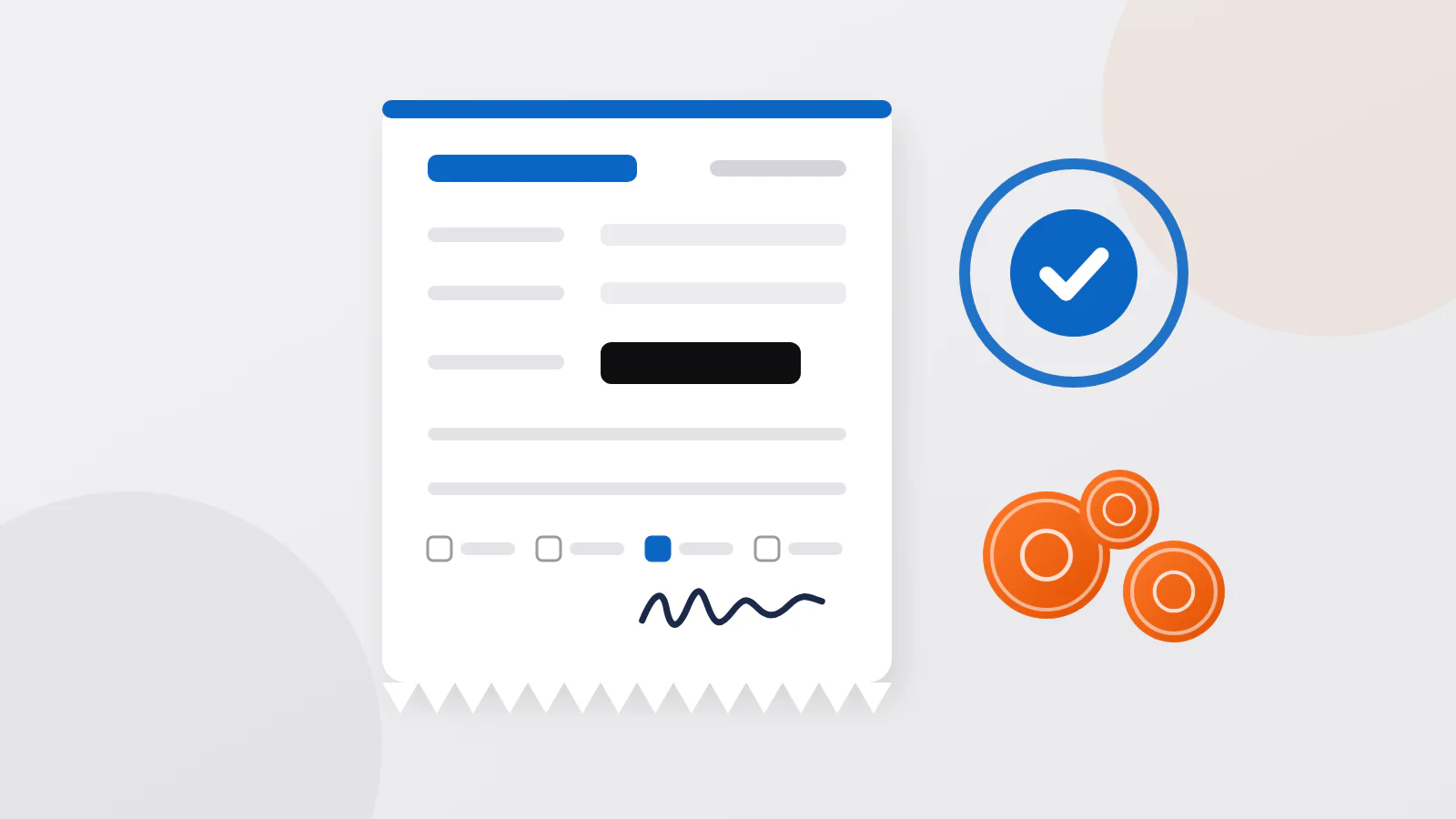
A payment receipt is your signed confirmation that money reached you: who paid, how much in figures and in words, what it was for, how it was paid, the date and what is still owed. Give one for every payment on a job (the deposit, each stage and the final balance) and keep a copy. It is not an invoice: an invoice asks for payment, a receipt confirms that it arrived.
Download three printable receipts on one page (PDF)
When to give a receipt
Every time money changes hands on a job:
- the deposit before you start,
- each stage payment on a longer job,
- the final balance when the work is handed over,
- a refund, when you return money: then ask the client to sign a receipt for you.
Cash is the obvious case, because the receipt is the only record either of you has. Give one for a bank transfer, a card payment or a check too: your bank shows that money arrived, not which job it was for or what is still owed. The receipt ties the payment to the job.
Write the receipt when the money is actually in your hands or your account, never for money that is only promised.
What to write on a receipt
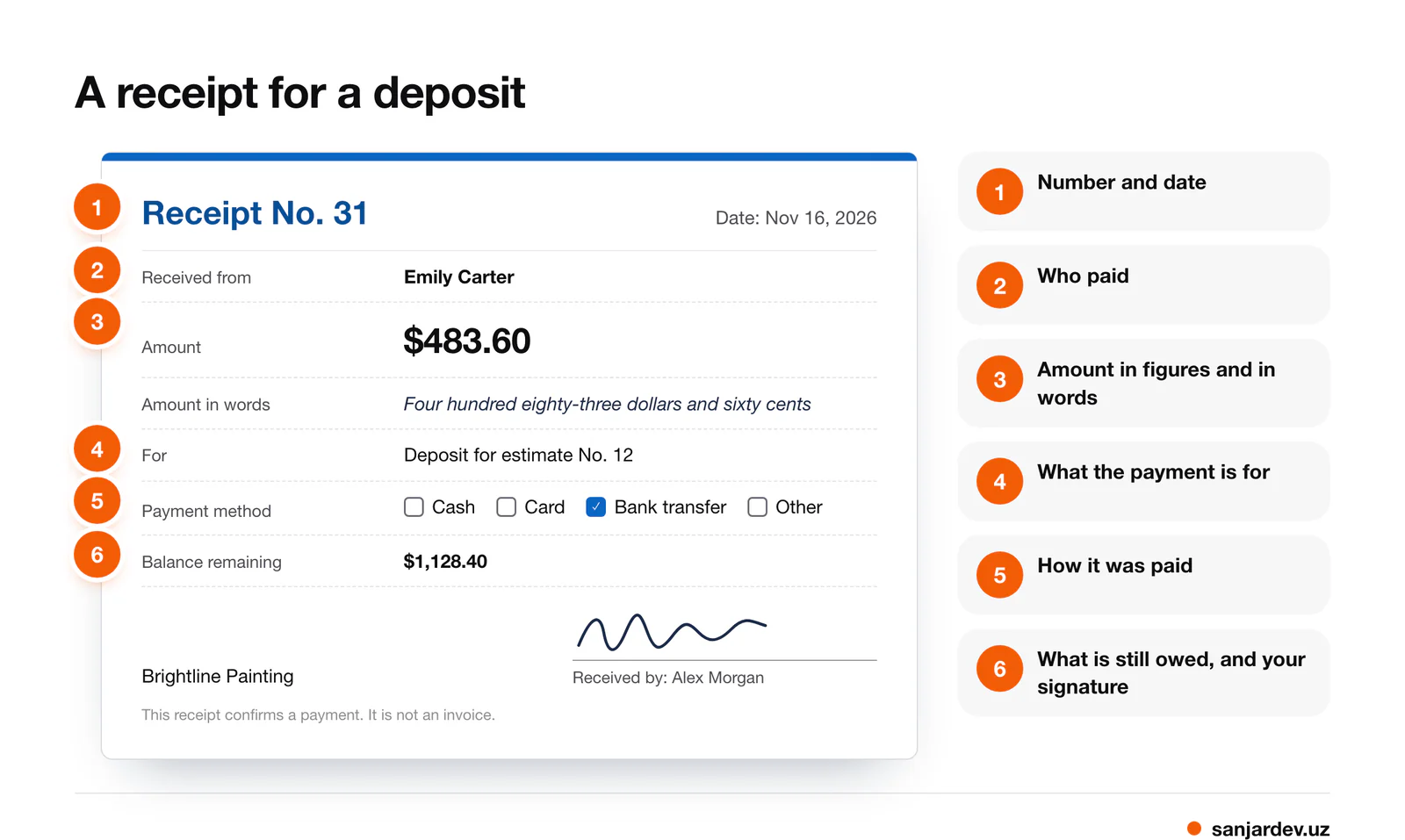
These are the six parts numbered on the sample:
- Number and date. Number receipts in one sequence (No. 31, 32, 33) and never reuse a number. The date is the day the money arrived.
- Who paid, as named on the estimate. If someone else pays, write both: "Received from Daniel Carter on behalf of Emily Carter".
- The amount in figures and in words (see below).
- What it is for, with a reference: "Deposit for estimate No. 12", "Stage 2 payment for estimate No. 12", "Final payment, completion report No. 5".
- How it was paid: cash, card, bank transfer, check or a payment app, with a reference such as the check number. Never write a full card number on a receipt.
- What is still owed, and your signature: the balance remaining after this payment, then your name and signature under "Received by".
Your business name and phone number go at the top, and the client's copy must match yours exactly. In the sample, receipt No. 31 confirms that Emily Carter paid $483.60 by bank transfer as the deposit for estimate No. 12, leaving a balance of $1,128.40.
How to write the amount in words
Figures are easy to change and easy to mistype; words are not. "$483.60" can become "$488.60" with one stroke, but "Four hundred eighty-three dollars and sixty cents" cannot, and a mismatch between the two shows a mistake at once. That is why checks carry the amount in words, and why it is worth doing on receipts, especially for cash.
- Write the words in full from the left edge, and draw a line through the empty space after them.
- Write cents as words or as a fraction: "Four hundred eighty-three and 60/100 dollars" is how US checks put it.
- If the figures and the words don't match, don't correct them: write VOID across the receipt, keep it and write a new one.
Deposit, stage and final receipts
Each receipt shows the same job at a different point, so only a few lines change:
| Payment | For | Amount | Balance remaining |
|---|---|---|---|
| Deposit | Deposit for estimate No. 12 | $483.60 | $1,128.40 |
| Final payment | Final payment, completion report No. 5 | $1,128.40 | $0.00, paid in full |
On a staged job, add a receipt for each stage payment, each with its own number and the balance after it. A partial payment receipt is simply a receipt whose balance is above zero: if the client pays $500.00 of a $1,128.40 balance, it shows $500.00 received and $628.40 still owed.
Receipt, invoice or tax document?
| Document | What it says | When |
|---|---|---|
| Estimate | what the job will cost | before the work |
| Invoice | please pay this amount by this date | after the work or a stage, before payment |
| Receipt | I have received this amount | when the payment arrives |
| Tax invoice, VAT invoice or fiscal receipt | a document whose content, and sometimes format, tax law sets | only where the law requires it |
Many small jobs never need an invoice: the client pays the balance at handover, and the estimate, the completion report and the receipt record everything. You may still need one when a business client pays only against an invoice, or when tax rules require one from you. Where the law requires a tax document, a simple receipt does not replace it. A receipt also proves only that you received money, not that the work was done and accepted; that is the job of a completion report.
Payments by transfer, card or check
- Bank transfer or payment app: write the receipt once the money shows in your account, with the date it arrived and the transfer reference.
- Card: the terminal slip records the card payment; your receipt adds what it was for and the balance.
- Check: write the check number, and if you give the receipt before the check clears, add "subject to clearance".
- Cash: count it with the client and write the receipt on the spot, before anyone leaves.
Keeping copies
Keep a copy of every receipt in number order, including spoiled ones marked VOID: a gap in the numbers is the first thing anyone checking your records asks about. A carbon receipt book does this for you; with loose forms, photograph each receipt before you hand it over. File receipts with the job's estimate and completion report, so one folder tells the whole story. How long to keep them depends on the tax rules where you work.
Receipts, invoices and tax rules
United States. The IRS says everyone in business must keep records, and lists receipts, invoices, deposit slips and canceled checks among the supporting documents; receipt books are named among the documents that show your gross receipts (Publication 583). Keep records at least until the period of limitations for the return runs out, which is generally 3 years. Two federal forms are worth knowing:
- Form 1099-NEC is not a receipt. A business that pays you $2,000 or more for services in a year may have to report it on Form 1099-NEC (the threshold for tax years beginning after 2025). A homeowner paying for work on their own home does not: personal payments are not reportable.
- Form 8300 for large cash payments. If you receive more than $10,000 in cash for one job, in one payment or related payments and including an advance, you must report it to the IRS on Form 8300, generally within 15 days.
United Kingdom. If you are self-employed, keep records of all sales and income, with proof such as bank statements and sales invoices, for at least 5 years after the 31 January submission deadline of the tax year. Only VAT-registered businesses can issue VAT invoices, and once registered you must issue one when you supply standard-rated or reduced-rated services to another VAT-registered business (VAT Notice 700/21). Registration is compulsory once your taxable turnover goes over £90,000 in 12 months, and you cannot charge VAT until you are registered. A receipt is not a VAT invoice.
FAQ
What is the difference between a receipt and an invoice?
An invoice asks the client to pay an amount by a date; a receipt confirms that you received a payment. A job can have both: an invoice for the balance, then a receipt when it is paid.
How do I write a receipt for a cash payment?
Count the money with the client, then fill in the number, the date, who paid, the amount in figures and words, what it was for, "Cash", the balance remaining and your signature. Give the client the original and keep the copy.
Can I write receipts by hand?
Yes. A handwritten receipt from a numbered receipt book is as good a record as a printed one, as long as it is complete, legible and signed. Keep the carbon copy or a photo.
What is a partial payment receipt?
A receipt for part of the price, such as a deposit or a stage payment. It shows the amount received and the balance still owed, so both of you can see where the job stands.
Do I need a receipt if the client paid by bank transfer?
It is still worth giving one. The bank record shows that money arrived, but not what it was for; the receipt links the transfer to the job and shows the balance.
How Quotio helps
Quotio, the app we develop for Android, keeps receipts with their job. Tap Record payment: until the deposit is paid, the amount comes filled in with the deposit from the estimate, after that with the balance due, and the "For" line reads, for example, "Deposit for estimate #12" or "Payment for completion report #5". Pick cash, card, transfer or other, and the receipt shows the balance after this payment, with your signature under "Received by". Receipts have their own numbering, which you can continue from a paper book. In English, Quotio prints the amount in figures only. The PDF goes to the client's WhatsApp or any other app. Free: 10 jobs a month with all their receipts; Quotio Pro is a yearly subscription with 7 days free. Quotio makes receipts, not invoices or tax documents. Quotio on Google Play
Sources
- Publication 583, Starting a Business and Keeping Records — Internal Revenue Service, 2024
- How long should I keep records? — Internal Revenue Service, 2026
- Instructions for Forms 1099-MISC and 1099-NEC — Internal Revenue Service, 2026
- IRS Form 8300 reference guide — Internal Revenue Service, 2026
- Business records if you're self-employed: what records to keep — GOV.UK, 2026
- Business records if you're self-employed: how long to keep your records — GOV.UK, 2026
- Record keeping (VAT Notice 700/21) — HM Revenue & Customs, 2024
- Register for VAT — GOV.UK, 2026
- Charge, reclaim and record VAT — GOV.UK, 2026
Written by Sanjar Jabborov, developer of Quotio. General information, not legal or tax advice: check the current rules where you work. Updated on 15 November 2026.