How to Price a Job: Labor, Materials and Markup (Free Calculator)
How to price a job as a contractor: work out your hourly rate, estimate the hours, add materials with waste and markup, then check the total. Free Excel calculator.

To price a job, add up your labor (the hours the job takes times an hourly rate that covers your pay, your business costs and the hours nobody pays you for), the materials with a waste allowance and a markup, and the other costs of that job, such as travel and disposal. Then compare the total with what similar jobs sell for, round it, and put it in a written estimate. The free Excel calculator below does the math for each step.
Download the job price calculator (Excel)
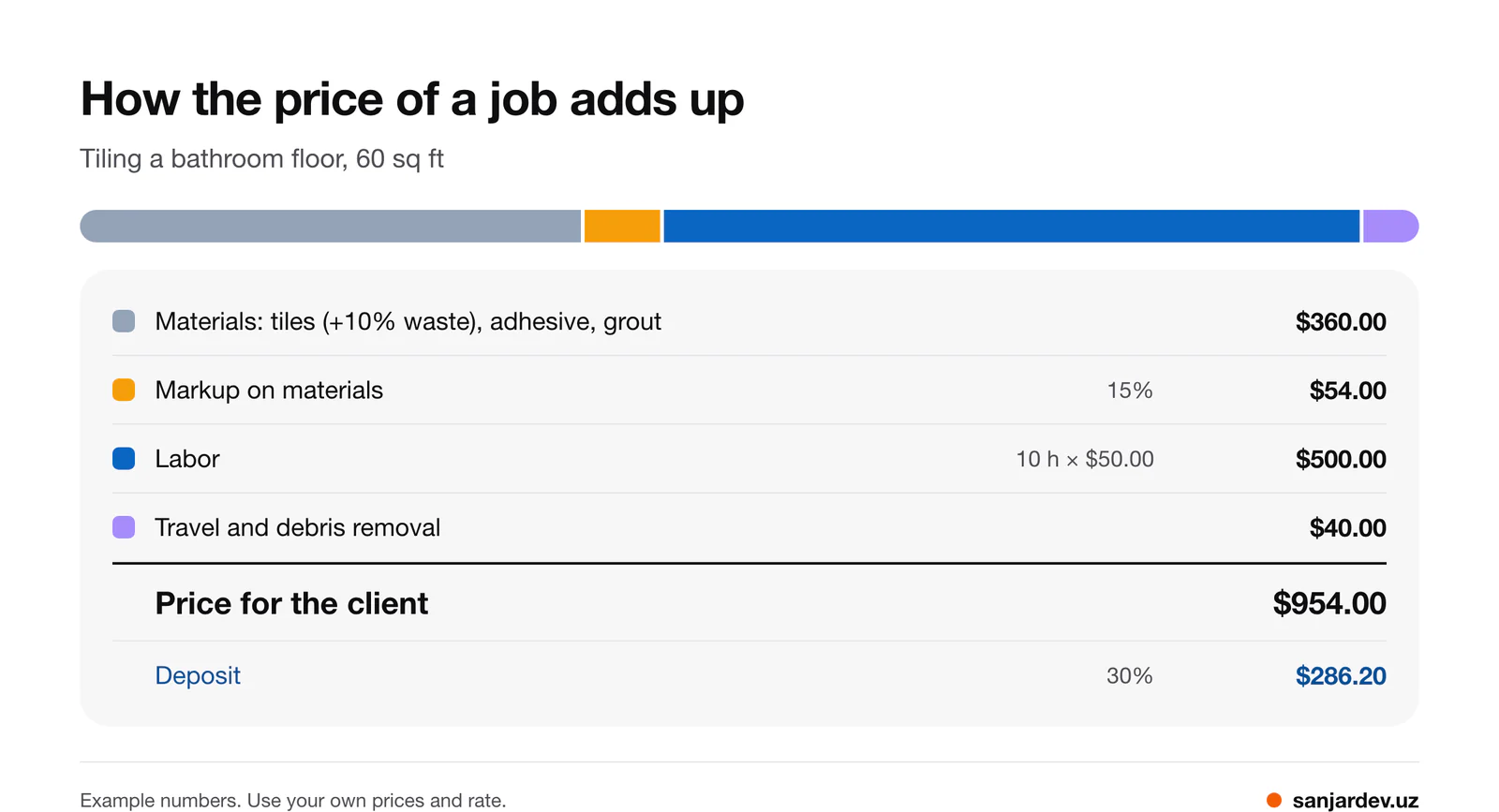
What a price is made of
| Part | What it covers | In the example |
|---|---|---|
| Labor | the hours on the job × your hourly rate | 10 h × $50.00 = $500.00 |
| Materials | everything the job uses, plus waste | $360.00 |
| Markup on materials | your time buying and collecting them, and the risk | 15%: $54.00 |
| Other job costs | travel, parking, disposal, rentals, permits | $40.00 |
| Tax | only where it applies, see below | 0% |
| Price for the client | the sum | $954.00 |
Your own pay is not a separate line: it is built into the hourly rate. That is why the rate has to be calculated from your numbers, not copied from someone else's. The calculator's Job price sheet follows the same order: you type the materials, markup, hours, other costs, tax and deposit, and it takes the hourly rate from the first sheet.
Step 1: work out your hourly rate
The Hourly rate sheet of the calculator needs four numbers. In the example:
- Income you want per month, before tax: $5,000.
- Business costs per month: vehicle, fuel, tools, insurance, phone, software, advertising. The example uses $1,300.
- Working days per month: 21.
- Billable hours per day: 6.
That makes 126 billable hours a month, and the rate is ($5,000.00 + $1,300.00) / 126 = $50.00 an hour.
Be honest about the billable hours. A long working day includes driving between jobs, picking up materials, visits to write estimates and paperwork, and no client pays for those hours directly. If you can bill six hours a day, enter six, not eight. And 21 working days every month leaves nothing for holidays, sick days or a slow season: if you expect fewer billable days over the year, enter fewer, and the rate goes up. The income figure comes before income tax and, where you pay them yourself, social contributions, so set it high enough to cover them.
Step 2: estimate the hours
Split the job into tasks and estimate each one: preparation, the work itself, waiting for something to dry or cure, cleanup. Your own records are the best guide, so note how long similar jobs took, per room or per square foot, and update the figures every few jobs. Add the time clients don't see, such as moving furniture, protecting floors or a trip to the supplier, and in an older house allow for surprises behind the tiles or under the paint.
The example assumes 10 hours for a 60 sq ft bathroom floor (about 5.6 square meters), including preparation and grouting. If you price per unit, per square foot, outlet or door, the logic is the same: your hourly rate divided by the units you finish in an hour gives the labor price per unit.
Step 3: price the materials, with waste and markup
List everything the job consumes, not only the main material: for tiling, the tiles, adhesive, grout, spacers and sealer; for painting, the paint, primer, filler, tape and sandpaper. Use current prices from your supplier, and let the "valid until" date on your estimate protect you if they change.
Add a waste allowance, because tiles get cut and break and some paint stays in the can. The example adds 10% to the tiles; layouts with many cuts need more. Then add your markup. Buying materials takes your time (choosing, ordering, collecting, returning what is left), ties up your money and makes you answer for them if something is wrong. In the example, 15% on $360.00 of materials is $54.00.
Markup is not margin
Markup is a percentage of your cost; margin is a percentage of the selling price. The $54.00 is 15% of the $360.00 cost but only 13.0% of the $414.00 price.
| Markup on cost | Margin on price |
|---|---|
| 10% | 9.1% |
| 15% | 13.0% |
| 25% | 20.0% |
| 50% | 33.3% |
| 100% | 50.0% |
To reach the margin you want, divide the cost by one minus that margin: $360.00 / (1 − 0.20) = $450.00 gives a 20% margin, which is a 25% markup. Mixing the two up is an easy way to earn less than you planned.
Step 4: add the other job costs
Some costs belong to one job and should be priced into it, not hidden in your rate: travel to a distant site, parking or tolls, dump fees, equipment rental, permits, and any subcontractor, such as an electrician on a remodel. The example adds $40.00 for travel and debris removal.
Step 5: add it up and check it
In the example, $360.00 + $54.00 + $500.00 + $40.00 = $954.00 before tax, or $15.90 per square foot. Before you send it, check:
- Your past jobs. Is the price per square foot, per room or per day in line with similar jobs that paid off?
- The risk. If the job takes a quarter longer than planned, is the price still worth it? If not, add time or describe the scope more tightly.
- The deposit. A 30% deposit, $286.20 here, does not cover the $360.00 of materials you buy up front. How much to ask for is in our guide to deposits.
- Rounding. If you round the total, round up.
Then put the price into an estimate with labor and materials on separate lines, as how to write a job estimate shows.
Hourly, per unit or a fixed price?
| Method | Suits | Watch out for |
|---|---|---|
| By the hour, plus materials | repairs, unclear scope, old houses | clients fear the job will drag on: agree a cap or regular updates |
| Per unit (sq ft, piece, outlet) | painting, tiling, flooring, repeat work | small jobs: set a minimum |
| Fixed price for the job | a clear scope you have done many times | overruns are yours, so describe the scope exactly |
Clients tend to prefer a fixed total, because they know what they will pay. You can still calculate the job by the hour and quote one price.
Minimum charge and trip fees
A 20-minute repair still costs you the drive, the parking and the setup. Set a minimum charge, such as one hour of labor, or a trip charge (a call-out charge in the UK) that covers the visit and the start of the work. Tell clients before you go, in your first message or on your website, so it never comes as a surprise.
Check the price against your market
Your calculation shows what you need; the market shows what clients will pay. Keep track of how many of your estimates are accepted: if almost all of them are, your prices are probably lower than they need to be; if most are turned down, look at the price and at how clearly the estimate is written. Ask suppliers and other tradespeople what work goes for locally, and look at the prices that businesses near you publish. If the market pays less than your calculated rate, cut costs or unbilled hours, or move toward work that pays better, rather than working below cost.
Tax on the price
United States. Whether you add sales tax depends on where you work and on the kind of work: tax laws vary by state and locality, so check with your state's revenue department (the U.S. Small Business Administration links to each one). In Texas, for example, labor to repair or remodel a home is not taxable, while the total charge for repairing or remodeling commercial property is; and on a lump-sum home job, the contractor pays the tax on materials when buying them and charges the client none. So the way you write the estimate can change the tax.
United Kingdom. You must register for VAT when your taxable turnover for the last 12 months goes over £90,000, or you expect it to go over £90,000 in the next 30 days. Once registered, you include VAT at the correct rate in your prices, and the price you give a consumer before they agree must include taxes (Consumer Contracts Regulations 2013, Schedules 1 and 2). Until you have a VAT registration number, you cannot include VAT on your invoices.
FAQ
What is a typical markup on materials?
There is no standard figure: it depends on your trade, how much time buying takes and the risk you carry. Work it out from your costs, see what clients accept, and remember that markup and margin are different numbers. The example uses 15%.
How do I calculate the labor cost of a job?
Estimate the hours task by task and multiply them by your hourly rate: 10 hours at $50.00 is $500.00 in the example. The rate itself is the income you want plus your business costs, divided by the hours you can bill.
How much should I charge per hour as a handyman?
Enough to cover your pay, your costs and the hours you can't bill. Work it out on the Hourly rate sheet, then compare it with what local clients pay. A rate copied from someone else ignores your own costs and hours.
Should I charge by the hour or a flat rate?
By the hour when the scope is unclear, a fixed price when you know the job well. Clients often find a fixed total easier to say yes to, so many tradespeople calculate by the hour and quote one price.
What is a trip charge?
A fee for coming out to the client that covers travel and setup whether or not the job goes ahead; in the UK it is called a call-out charge. Say it up front, and say whether it comes off the bill if the client hires you.
How Quotio helps
Quotio, the app we develop for Android, doesn't work out your rate or markup; use the calculator for that. What Quotio does is keep the resulting prices: each item in your price list keeps its unit (sq ft, ft, hours, days, pieces or your own) and its price, so the next estimate takes a few taps; the ready items for 10 trades come without prices, since those are yours. On the estimate, labor and materials get separate subtotals, and tax goes on top of prices or is included in them. The monthly report shows how many of your estimates were accepted, a quick check on your prices. Free: up to 30 of your own price list items and 10 jobs a month. Quotio Pro, a yearly subscription with 7 days free, removes both limits and adds past months' reports. It makes estimates, completion reports and receipts, not invoices or tax documents. Quotio on Google Play
Sources
- Pay taxes — U.S. Small Business Administration, 2026
- Real Property Repair and Remodeling, Publication 94-116 — Texas Comptroller of Public Accounts, 2007
- Register for VAT — HM Revenue and Customs, GOV.UK, 2024
- How VAT works — HM Revenue and Customs, GOV.UK, 2024
- The Consumer Contracts (Information, Cancellation and Additional Charges) Regulations 2013, Schedules 1 and 2 — legislation.gov.uk, 2013
Written by Sanjar Jabborov, developer of Quotio. General information, not legal or tax advice: check the current rules where you work. Updated on 15 November 2026.