Payroll in Uzbekistan 2026: Income Tax, Social Tax and an Example
Payroll in Uzbekistan in 2026: 12% income tax with the 0.1% INPS share inside it, 12% social tax, the minimum wage, overtime pay and a free Excel calculator.

In 2026 an employer in Uzbekistan withholds 12% personal income tax from each employee's gross salary and pays 12% social tax on top of it from its own money. The 0.1% pension contribution (INPS) is not a third deduction: it is paid out of the 12% income tax. A gross salary of 5,000,000 so'm therefore gives the employee 4,400,000 so'm and costs the employer 5,600,000 so'm.
The three payments on every salary
Gross salary is the amount written in the employment contract, before tax. Net pay is what the employee actually receives. Between the two stand three payments:
| Payment | Who bears it | Rate in 2026 | Where the money goes | Deadline |
|---|---|---|---|---|
| Personal income tax | the employee; the employer withholds it | 12% of gross pay | state budget | when wages are paid, no later than the 15th of the next month |
| INPS pension contribution | part of the income tax | 0.1% of gross pay | the employee's pension account at Xalq banki | together with the income tax |
| Social tax | the employer, on top of the salary | 12% of the payroll (25% for budget organisations) | state budget | every month, by the 15th of the next month |
The employer acts as a tax agent: it calculates the income tax, keeps it back from the salary and pays it to the budget (Tax Code, Art. 386). The tax is counted every month on a running total from the start of the year (Art. 388). With one flat rate the result is the same as 12% of each month's pay, so for an ordinary salary you can simply multiply.
INPS stands for the individual accumulative pension account. By law the employer pays the contribution by reducing the income tax it has calculated: of the 12% withheld, 0.1% of the salary goes to the employee's INPS account and the remaining 11.9% goes to the budget (Law No. 702-II, Art. 10; Tax Code, Art. 385; Presidential resolution PP-4086, item 5). The employee does not lose anything extra, and net pay stays at 88% of gross.
Worked example: a salary of 5,000,000 so'm
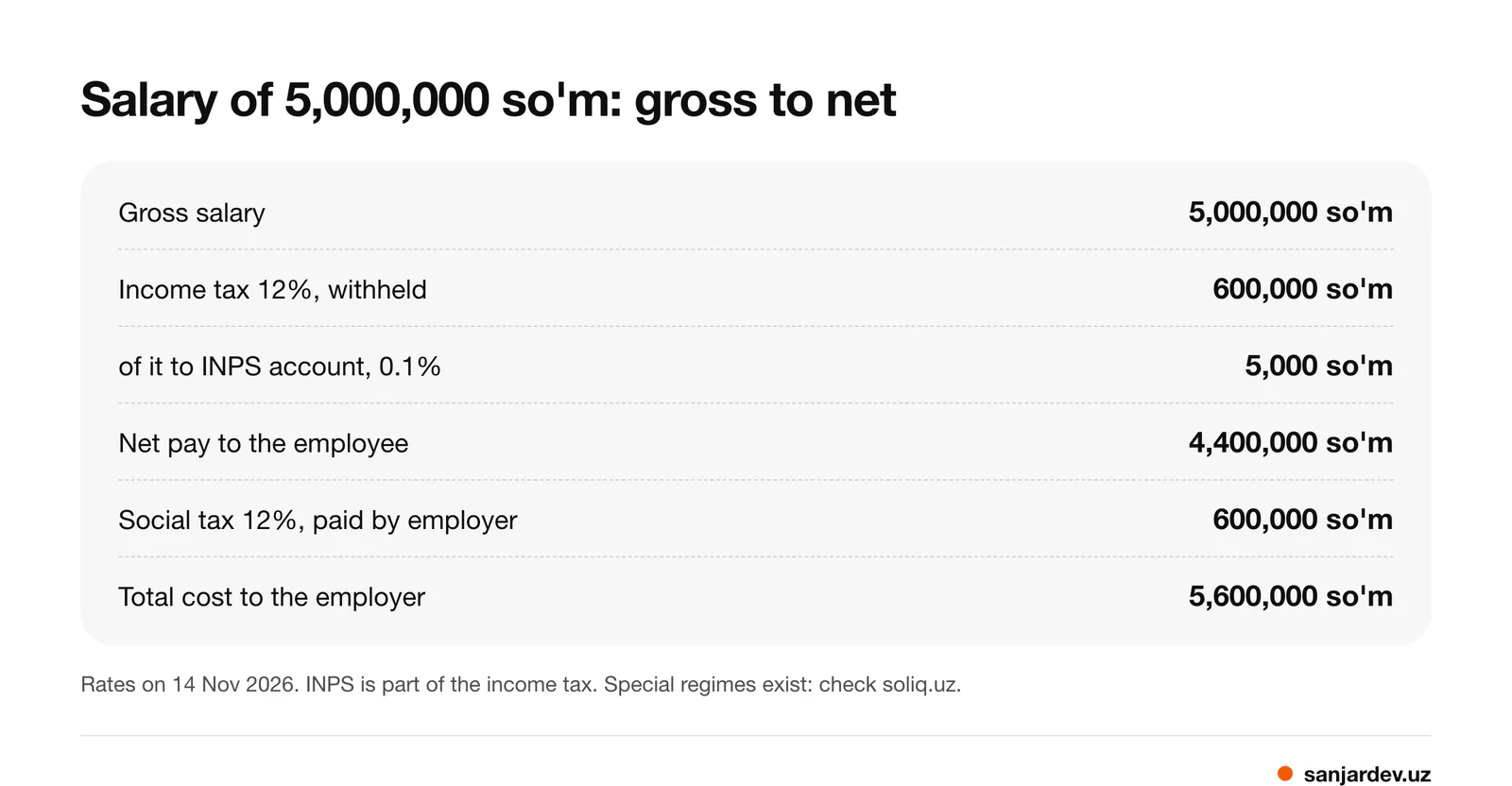
- Gross salary in the contract: 5,000,000 so'm.
- Personal income tax at 12%: 5,000,000 × 0.12 = 600,000 so'm, withheld from the salary.
- Of this tax, 0.1% of the salary, 5,000 so'm, goes to the employee's INPS account; 595,000 so'm goes to the budget.
- Net pay: 5,000,000 − 600,000 = 4,400,000 so'm.
- Social tax at 12%, paid by the employer on top: 600,000 so'm.
- Total monthly cost of the employee: 5,000,000 + 600,000 = 5,600,000 so'm.
Two shortcuts follow from this: net pay is gross × 0.88, and the total cost is gross × 1.12. If you have promised a salary "in hand", divide it by 0.88 to get the gross figure for the contract: 4,400,000 so'm net means 5,000,000 so'm gross.
The same calculation for other salaries:
| Gross salary, so'm | Income tax 12% | of it INPS 0.1% | Net pay | Social tax 12% | Total cost |
|---|---|---|---|---|---|
| 1,360,000 (minimum wage) | 163,200 | 1,360 | 1,196,800 | 163,200 | 1,523,200 |
| 3,000,000 | 360,000 | 3,000 | 2,640,000 | 360,000 | 3,360,000 |
| 5,000,000 | 600,000 | 5,000 | 4,400,000 | 600,000 | 5,600,000 |
| 8,000,000 | 960,000 | 8,000 | 7,040,000 | 960,000 | 8,960,000 |
Minimum wage and the base calculation amount in 2026
- Minimum wage. Since 1 September 2026 the minimum wage is 1,360,000 so'm a month (Presidential decree UP-115 of 23 June 2026). From 1 August 2025 to 31 August 2026 it was 1,271,000 so'm.
- What it protects. An employee who has worked the full monthly norm of hours and done the agreed work may not be paid less than the minimum wage. Bonuses and the extra pay for overtime, night work and holidays do not count towards it (Labour Code, Art. 245). Part-time work is paid in proportion to the time worked (Art. 186).
- Base calculation amount (BHM). Since 1 September 2026 it is 440,000 so'm, up from 412,000 so'm. It is not a wage: administrative fines are set in multiples of it (Code of Administrative Responsibility, Art. 25), and so are some minimum taxes, such as the social tax of individual entrepreneurs described below.
Overtime, night work and public holidays
| Situation | Minimum pay | Rule |
|---|---|---|
| Overtime | first two hours in a day at least 1.5 times the rate, later hours at least double | Labour Code, Art. 262 (wording in force since 12 November 2025) |
| Overtime limit | no more than 4 hours over two days in a row, with the employee's written consent | Art. 189, 190 |
| Night work, 22:00 to 06:00 | at least 1.5 times the rate | Art. 188, 264 |
| Work on a day off or a public holiday | at least double; salaried staff get at least one extra day's or hour's rate on top of the salary | Art. 263 |
Here is how it adds up. An employee with an hourly rate of 30,000 so'm stays three hours longer one evening. The first two hours cost at least 2 × 45,000 = 90,000 so'm and the third at least 60,000 so'm, so the evening costs 150,000 so'm extra. Instead of the higher pay, the employee may choose extra time off; the overtime is then paid at the single rate (Art. 262). The same choice exists for work on a day off (Art. 263).
All of this depends on accurate hours, so keep a monthly attendance timesheet.
When to pay wages and taxes
- Wages are paid at least every half-month. A monthly salary is paid in two parts, an advance and the rest, as a rule no more than 16 days apart (Labour Code, Art. 253). If payday falls on a day off, pay the day before. When an employee asks, you must explain what was accrued and what was deducted.
- Income tax and INPS are paid when you pay the salary and no later than the 15th of the following month, which is also the deadline for the monthly report (Tax Code, Art. 389 and 390; INPS regulation No. 3577).
- Social tax is calculated every month and paid and reported by the 15th of the following month; the annual report is due by 15 February (Tax Code, Art. 407).
For November 2026 wages, for example, the reports and payments are due by 15 December 2026. Salaries are also your biggest regular expense, so record them in your cash book as well.
Special cases to check with an accountant
The rates above are the general ones. Check these situations before you rely on them:
- An individual entrepreneur (YaTT) as employer. The entrepreneur withholds the 12% income tax from employees in the same way as a company (Tax Code, Art. 385 and 386). The social tax works differently: instead of 12% of wages it is at least one BHM per employee per year, currently at least 440,000 so'm, paid by 31 December (Art. 408).
- Budget organisations pay 25% social tax, and a few other groups have lower rates; the President can also set reduced rates for some taxpayers (Art. 405).
- Employees with tax benefits. Some people, for example those with a disability of group I or II or single mothers with two or more children under 16, have part of their income exempt once they bring the documents (Art. 380).
- Foreign employees. Someone who spends more than 183 days in Uzbekistan within any twelve months is a tax resident (Art. 30). Employment income of non-residents is also taxed at 12% (Art. 382), but a tax treaty can change the result.
- Special regimes, such as those for IT Park residents, exist. Check your company's regime on soliq.uz or with your accountant.
Rules change often: the income tax chapter of the Tax Code was amended again on 25 December 2025. Check the current text on lex.uz before each new year.
How to use the payroll calculator
Download the payroll calculator (Excel)
- Type each employee's name and gross monthly salary.
- The sheet works out the income tax, the INPS part of it, net pay, social tax and the total cost, with totals at the bottom.
- The three rates sit in separate cells at the top. If the law changes, change the rate, not the formulas.
- The calculator uses the general rates only. For an entrepreneur employer, budget organisations, tax benefits or special regimes, ask your accountant.
FAQ
What is the personal income tax rate in Uzbekistan in 2026?
12% on employment income, both for residents and for non-residents. Residents pay 5% on dividends and interest (Tax Code, Art. 381 and 382).
Is INPS deducted from the salary on top of the income tax?
No. The 0.1% INPS contribution is part of the 12% income tax: the employer sends 0.1% of the salary to the employee's pension account and the rest of the tax to the budget. Net pay stays at 88% of gross.
What is the minimum wage in Uzbekistan in 2026?
1,360,000 so'm a month since 1 September 2026, and 1,271,000 so'm before that date (decrees UP-115 and UP-91).
How much does an employee cost the employer?
On the general rate, the gross salary plus 12% social tax: 5,600,000 so'm a month for a gross salary of 5,000,000 so'm. Budget organisations pay 25%, and individual entrepreneurs pay a fixed minimum per employee instead.
Do foreigners pay income tax in Uzbekistan?
Yes. Employment income from Uzbekistan is taxed at 12% whether the employee is a resident or not; residency follows the 183-day rule, and a tax treaty may change the result.
How MyBizz helps
MyBizz (App Store, Google Play) is the app we develop for running a small business. It keeps the payroll sheet of a team: monthly salaries, daily and hourly rates, piecework, sales commission and advances, with every accrual, deduction and payout on the employee's card. When you pay a salary, the payout can go straight into the cash book as an expense. MyBizz does not calculate income tax or social tax and does not file reports: your accountant or accounting program does that, and you can enter the withheld tax as a deduction. The app is free to download and free during the trial period; after that a company needs a paid plan, priced by the number of employees.
Sources
- Tax Code of the Republic of Uzbekistan, Art. 30, 380–390, 402–408 (in Russian) — lex.uz, 2019, amended 2026
- Labour Code of the Republic of Uzbekistan, Art. 186–190, 245, 253, 262–264 (in Russian) — lex.uz, 2022, amended 2026
- Decree UP-115 on raising wages, pensions, stipends and benefits (in Russian) — lex.uz, 2026
- Law No. 702-II on accumulative pension provision of citizens, Art. 10 (in Russian) — lex.uz, 2004
- Presidential resolution PP-4086, item 5: INPS contribution of 0.1% (in Russian) — lex.uz, 2018
- Regulation No. 3577 on employers' INPS contributions (the regulation is in Uzbek, the approving resolution also in Russian) — lex.uz, 2024
- Code of Administrative Responsibility, Art. 25: fines in multiples of the BHM (in Uzbek) — lex.uz, 1994
- Tax Committee of the Republic of Uzbekistan — Tax Committee, 2026
Written by Sanjar Jabborov, developer of MyBizz. Checked against the Tax Code and the Labour Code of Uzbekistan (lex.uz). Updated on 14 November 2026. This is general information, not tax advice: special regimes exist and rules change, so check soliq.uz or ask an accountant.